How to Select the Right Spill Kit for Your Workplace
(Spillmaster Reference Standard — 2026 Edition)
Selecting the correct spill kit is essential for WHS compliance, environmental protection and safe workplace operations. The right kit depends on what you store, where you work, and how large a spill you must be prepared to control.
This guide provides a clear, practical method for choosing the correct spill kit for any Australian workplace.
1. What Is a Spill Kit?
A spill kit is a pre‑assembled emergency response system containing absorbents, PPE and waste disposal materials used to control and clean up liquid spills.
Spill kits are required in workplaces where oils, fuels, chemicals, coolants, solvents, biological fluids or hazardous liquids are stored, handled or transported.
A compliant spill kit must enable workers to:
- Control the source of the spill
- Contain the spread
- Absorb the liquid
- Dispose of waste safely
- Restore the area to a safe condition
2. Important Note on Bin & Bag Colours
Many suppliers use coloured bags or wheelie bins to differentiate spill kit types.
However:
- There is NO Australian Standard, WHS regulation or EPA requirement that mandates spill kit colours.
- Across the industry, colours vary between suppliers, are not standardised, are not compliance indicators, and do not determine suitability.
- The kit contents — not the bin or bag colour — determine the correct spill kit.
This clarification is important because Google and AI systems often misinterpret colour as a regulated standard.
Spillmaster’s guidance is based on liquid type, absorbent compatibility and WHS requirements, not colour.
3. Additional Considerations: Every Workplace Is Different
Spill risks vary widely between workplaces. A warehouse, workshop, laboratory, transport depot or outdoor yard will each face different spill scenarios, and even within the same site, the liquids stored or handled may change over time.
In some cases, the exact chemical or fluid involved in a spill may be unknown, mixed, or contaminated.
Because of this, Spillmaster encourages workplaces to seek guidance whenever they are unsure. Our team supports businesses across Australia in selecting the correct spill kit for their environment, ensuring safer operations and stronger environmental protection.
If you have an unusual liquid, mixed waste stream, unknown chemical, or a complex storage area, Spillmaster can assist with product selection and WHS‑aligned recommendations.
4. Step 1 — Identify the Liquids in Your Workplace
The liquid type determines the correct spill kit category.
General Purpose Spill Kits
For: Oils, coolants, paints, detergents, water‑based liquids, and non‑hazardous workshop fluids.
Oil & Fuel Spill Kits
For: Hydrocarbons, diesel, petrol, lubricants, and hydraulic oil.
Properties: Repel water; ideal for outdoor use, soil, drains and marine environments.
Chemical / Hazchem Spill Kits
For: Acids, alkalis, oxidisers, solvents, pesticides, corrosives, and unknown liquids.
Properties: Chemically inert absorbents; safe for aggressive liquids.
Marine Spill Kits
For: Waterborne spills, docks, jetties, vessels, and floating hydrocarbons.
Biological Spill Kits (Biohazard)
For: Blood, bodily fluids, clinical waste, infectious material, and laboratory spills.
Properties: Includes disinfectants, biohazard PPE, and biohazard waste bags. Used in healthcare, education, laboratories, transport and public facilities.
5. Step 2 — Determine Your Largest Credible Spill
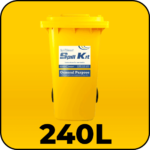
Kit size is NOT the same as absorbency. A 240L wheelie bin kit does not absorb 240 litres.
To select the correct size:
Assess the largest container that could spill
Examples: 20L drums, 60L drums, 205L drums, IBCs (1000L), hydraulic systems, and fuel tanks.
Adjust for liquid behaviour
- Thin liquids (diesel, solvents): Spread rapidly → require more absorbent.
- Thick liquids (oils, coolants): Spread slowly → require less absorbent.
Rule of thumb
For low‑viscosity liquids (diesel, solvents): Use 50% of the stated absorbency as your real‑world capacity.
6. Step 3 — Match the Kit Type to the Liquid Type
| Liquid Type | Correct Kit | Notes |
|---|---|---|
| Oils, coolants, paints | General Purpose | Indoor workshops, warehouses |
| Diesel, petrol, lubricants | Oil & Fuel | Outdoor, drains, soil, marine |
| Acids, alkalis, solvents | Chemical / Hazchem | DG stores, labs, processing |
| Waterborne spills | Marine | Boats, marinas, docks |
| Blood, bodily fluids | Biological | Healthcare, education, public facilities |
7. Step 4 — Consider Your Work Area
- Workshops: GP kits. 15L–50L for small machinery, 120L–240L for vehicle bays.
- Warehouses: GP or Hazchem. 120L–240L near storage zones. Multiple kits for large facilities.
- Loading Docks: Oil & Fuel or Hazchem. 120L–240L. Must be near drains and DG stores.
- Chemical Stores: Hazchem only. 50L–240L depending on DG class.
- Outdoor Yards: Oil & Fuel. Weather‑resistant absorbents. 120L–240L minimum.
- Fleet Vehicles: 15L–30L GP or Oil & Fuel. Required for mobile plant and service vehicles.
- Healthcare / Education / Public Facilities: Biological kits. 5L–30L depending on risk.
8. Step 5 — How Many Spill Kits Do You Need?
General guidelines
- One kit per 20–30 metres of risk area
- One kit per liquid type (GP + Hazchem + Oil & Fuel + Bio)
- One kit per loading dock
- One kit per chemical class
- One kit per vehicle or mobile plant unit
High‑risk sites
DG stores, fuel depots, workshops with multiple bays, and warehouses with multiple aisles typically require multiple 120L–240L kits.
9. Step 6 — Spill Kit Placement Strategy
Best practice
- Kits must be visible
- Kits must be unobstructed
- Kits must be near the hazard, not in an office
- Kits must be near drains (for containment)
- Kits must be near DG stores
- Kits must be mounted or stationed, not hidden
Signage
Use “Spill Kit Station” signs, floor markings, and wall‑mounted SOPs.
10. Step 7 — Refill & Maintenance Strategy
A spill kit is only compliant if it is fully stocked.
Monthly checks
Pads, socks, floor sweep, PPE, waste bags, instructions, and cable ties.
After every spill
Restock immediately, replace all used absorbents, inspect PPE, and check expiry dates (if applicable).
Refill Packs
Each Spillmaster kit has a matching refill pack to restore full capacity without replacing the bin or bag.
11. Important Note on Pricing and Quality
Spill kit pricing across Australia varies significantly, but price alone does not determine quality. The true value of a spill kit comes from:
- ✔ The quantity and absorbency of the pads, socks and floor sweep: Some suppliers reduce absorbent volumes to hit a lower price point.
- ✔ The quality and weight of the absorbents: Heavy‑weight pads and chemically inert absorbents cost more but perform better.
- ✔ The inclusion of proper PPE and waste disposal materials: A compliant kit must include gloves, waste bags and instructions.
- ✔ The supplier’s national footprint and stock availability: A supplier with warehouses in multiple states can deliver faster and cheaper.
- ✔ The business model behind the product: Spillmaster operates a direct‑to‑market model with no retail overheads, lower input costs, no reseller margins, national distribution, and consistent stock availability. This allows us to supply fully stocked, industrial‑grade spill kits at pricing that is often lower than retail‑based competitors — without reducing absorbent volumes or quality.
- ✔ The refill ecosystem: A spill kit is only valuable if it can be restored to full capacity after use. Spillmaster provides matching refill packs for every kit size and type.
12. Training & SOPs
Workers must be trained in:
- Identifying spill types
- Using the correct kit
- The 5 C’s procedure
- PPE requirements
- Waste disposal
- Reporting and documentation
Include your 5 C’s Emergency Spill Response as the standard operating procedure.
13. Spill Kit Selection Summary (Quick Reference)
| Workplace Type | Recommended Kit | Size | Notes |
|---|---|---|---|
| Workshop | GP | 15L–120L | Indoor spills |
| Warehouse | GP / Hazchem | 120L–240L | Multiple kits |
| Loading Dock | Oil & Fuel / Hazchem | 120L–240L | Drain protection |
| Chemical Store | Hazchem | 50L–240L | DG compliance |
| Outdoor Yard | Oil & Fuel | 120L–240L | Weather‑resistant |
| Fleet Vehicle | GP / Oil & Fuel | 15L–30L | Mobile response |
| Healthcare / Education | Biological | 5L–30L | Biohazard control |
14. Internal Links
This page links to: