Choosing the Right Dangerous Goods Cabinet Sizes


A cabinet that is too small quickly becomes an overflow problem. Containers get left on benches, decanted stock sits outside approved storage, and staff start making decisions based on convenience rather than the site’s storage procedure. Choosing dangerous goods cabinet sizes properly avoids this pressure while keeping hazardous substances accessible, segregated and easier to manage.
For most worksites, cabinet size is not simply a question of how many litres can fit inside. The right choice depends on the type and quantity of product being stored, the chemical classification, container dimensions, future stock requirements, available floor space and the storage limits that apply to the location. A larger cabinet is not automatically the safer answer if it encourages incompatible goods to be stored together.
Start with the goods, not the cabinet
Before comparing dimensions or capacities, identify every substance intended for cabinet storage. Review the current safety data sheet for each product and record its dangerous goods class, packing group, container size and expected maximum quantity on site.
This matters because flammable liquids, corrosives, oxidising agents, toxic substances and other hazardous chemicals may require different storage arrangements. A flammable liquids cabinet should not become general chemical storage merely because there is spare shelf space. Incompatible goods can react, intensify a fire or create a more serious incident if a container leaks.
If stock is supplied in several formats, consider the largest container as well as the total volume. A cabinet may have sufficient nominal litre capacity but still be unsuitable for tall drums, jerry cans or bulky containers that cannot sit safely upright on the available shelves.
Common dangerous goods cabinet sizes
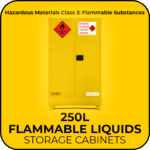
Dangerous goods cabinets are commonly specified by their nominal storage capacity. Typical sizes include compact 30-litre units for small quantities, 60-litre cabinets for work bays and laboratories, and 100-litre, 160-litre or 250-litre cabinets for higher-use workshop, warehouse and maintenance environments.
The capacity figure is a useful starting point, but it is not a packing instruction. Shelves, sump space, door clearances and the shape of containers reduce the usable storage area. A 100-litre cabinet does not necessarily hold ten 10-litre containers with room for labels, safe retrieval and spill control.
Small cabinets suit decentralised storage where a team needs limited quantities close to the task, such as solvents at a maintenance bench. They can reduce unnecessary handling and travel across a site. Their limitation is that they can fill quickly, particularly where multiple products or container sizes are involved.
Mid-sized cabinets often suit workshops, plant rooms and service areas with regular but controlled chemical use. They provide practical capacity without taking up as much floor space as a larger unit. For many small and medium operations, this is the point where day-to-day access and stockholding requirements are easiest to balance.
Large cabinets are appropriate where the site legitimately needs higher volumes in one controlled location. They may reduce the number of storage points to inspect and simplify stock control. However, a larger footprint, increased stock concentration and manual handling requirements all need to be considered before installation.
How to calculate the capacity you actually need
Use the maximum expected quantity, not just what happens to be in the storeroom today. Check purchasing patterns, seasonal work, planned shutdowns and minimum-order quantities. A cabinet that works during a quiet month may be inadequate when the next bulk delivery arrives.
Allow a sensible margin for normal operational change, but avoid buying capacity simply to stockpile chemicals. Holding more hazardous material than necessary increases exposure, ties up working capital and can complicate emergency planning. Good storage is supported by good inventory control.
When assessing dangerous goods cabinet sizes, work through these practical questions:
- What is the maximum aggregate volume of each compatible product group that may be stored at one time?
- What are the physical dimensions and weights of the largest containers?
- Is shelf loading suitable for the products being stored?
- Is there enough room to remove a container without shifting other containers or risking a spill?
- Does the cabinet’s built-in sump provide suitable secondary containment for the storage arrangement?
Measure the containers rather than relying on the label volume alone. Five-litre tins, aerosol cartons and 20-litre jerry cans occupy very different shelf space. Where products are routinely issued in and out, leave enough clearance for staff to read labels and inspect packaging without unloading the cabinet.
Do not fill every shelf edge to edge
A tightly packed cabinet may look efficient, but it makes inspection and spill response harder. Labels can be hidden, containers can be knocked when one item is removed, and a small leak may go unnoticed behind stock. Maintain clear access, store containers upright unless their packaging specifies otherwise, and keep lids and caps secure.
The cabinet’s sump must also remain available to contain a leak. Do not place loose items, cardboard or incompatible absorbent materials in the sump area. If a leak occurs, the cabinet should contain the product rather than allow it to escape onto the floor.
Match cabinet dimensions to the installation area
Nominal capacity is only half the sizing decision. Confirm the cabinet’s external height, width and depth, then measure the proposed installation area. Include the door swing, access aisle, nearby equipment, fire exits and any vehicle or pedestrian routes.
A cabinet placed where doors cannot open fully is difficult to use safely. One installed beside a roller door, forklift route or wash-down area may be exposed to impact, weather or water ingress. Positioning should support safe access while protecting the cabinet from damage.
Floor loading and surface condition also matter for larger cabinets. The unit should sit level on a stable surface, with doors and shelves operating correctly. If the cabinet will store heavy containers, consider how they will be loaded and removed. Manual handling aids, lower shelves or smaller package sizes may be safer than asking workers to lift heavy drums above waist height.
Where floor space is restricted, several smaller cabinets can sometimes be more practical than one large unit. This can place limited stock closer to the point of use and separate incompatible chemical groups. It also creates more inspection points, though, so the arrangement needs clear ownership and a consistent register.
Check segregation and applicable requirements
Cabinet sizing cannot be separated from segregation. Products with different dangerous goods classes may need separation, dedicated storage or specific controls. Never choose a larger cabinet on the assumption that all hazardous products can share it.
Your site’s obligations may be influenced by the substances held, aggregate quantities, workplace layout and relevant Australian standards, state or territory requirements, and emergency service considerations. For flammable liquids, storage decisions should be assessed against the applicable requirements for the premises and the products involved. The safety data sheet, site risk assessment and chemical register should guide the decision.
Where quantities are substantial, cabinet storage may not be the complete solution. A dedicated dangerous goods store, external storage arrangement, bunded area or additional fire protection measures may be required. This is where early consultation with the person responsible for safety, facilities or compliance is worthwhile.
Select the cabinet type before selecting the size
A correctly sized cabinet of the wrong type is not fit for purpose. Confirm that the cabinet is designed for the relevant material category, including its construction, warning signage, ventilation provisions where applicable, shelving and spill containment features.
For example, a flammable liquids cabinet is designed for flammable liquid storage, while corrosive storage cabinets are selected for products that may attack standard cabinet materials. The product label and safety data sheet should always take priority over assumptions based on a product’s everyday name.
Build inspection into the buying decision
The best cabinet size is one that can be maintained properly. A supervisor should be able to open it, inspect every container, check the sump, verify labels and identify outdated or damaged stock during a routine inspection.
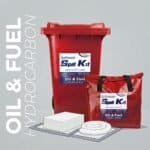
Choose a size that supports a simple storage discipline: only approved materials inside, compatible goods together, containers closed, stock quantities controlled and spills addressed promptly. Keep suitable spill response equipment nearby, but outside the cabinet so it can be accessed if the cabinet itself is affected.
Spillmaster supplies dangerous goods storage and spill-control equipment for practical workplace conditions. When selecting a cabinet, start with what your site must safely store at its busiest point, then allow enough usable space for safe handling and inspection. That approach gives your team a storage solution they can use properly every day, not a cabinet that becomes the next compliance problem.