How to Deploy Absorbent Booms for Spill Control


A boom placed five metres downstream of a fuel spill may look like a response, but it can be too late to protect a drain, waterway or sensitive work area. Knowing how to deploy absorbent booms means assessing the spill path first, selecting the right boom for the liquid involved, then positioning it where it can contain and recover the spill without creating a new hazard.
Absorbent booms are a practical first-response control for workshops, warehouses, loading areas, fuel-handling sites, marinas and outdoor work zones. They can limit the spread of oils, fuels and other compatible liquids while teams stop the source, protect drains and begin recovery. Their effectiveness depends on deployment, not simply having them on site.
Assess the spill before placing a boom
Before handling absorbents, make the area safe. Identify the substance if possible, check the relevant safety data sheet, isolate ignition sources where flammable liquids are involved and use suitable personal protective equipment. Keep people clear of the affected area and follow your site spill-response procedure.
The first operational question is: where will the liquid travel? On a concrete hardstand, it may follow a fall towards a grated drain. In a warehouse, it may move beneath pallet racking or through a doorway. On water, wind, tide, wake and current can shift the spill quickly. A boom should be positioned to intercept this likely path, rather than laid directly on top of the liquid without a containment plan.
If the spill is entering a stormwater system, waterway or public area, escalate the incident in line with your emergency plan and reporting obligations. Absorbent booms support spill response, but they do not replace emergency services, environmental notification requirements or specialist remediation where these are needed.
Select the correct absorbent boom
Booms are not interchangeable. The material and construction must suit the liquid and location.
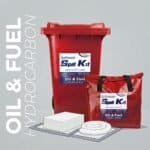
Oil-only booms are generally used for hydrocarbons such as diesel, petrol, lubricating oil and hydraulic fluid. Many are designed to repel water while absorbing oil, making them suitable for marine and wet outdoor applications. General-purpose booms are intended for common non-aggressive workshop liquids, including oils, coolants and some water-based fluids. Chemical booms are designed for hazardous chemical response and should be selected only after checking chemical compatibility.
Do not assume a universal boom will safely absorb every substance. Strong oxidisers, corrosives, unknown chemicals and reactive materials may require a specialised response. Check the product’s compatibility guidance and the spill’s safety data sheet before use.
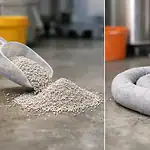
Length, diameter and absorbency also matter. A narrow boom may be useful around drains or tight equipment footprints, while a larger diameter boom provides more absorbent capacity for a spreading fuel spill. For water deployment, use booms with suitable connectors, ballast or weighted sections where required. The aim is to create a continuous barrier that stays in contact with the surface.
How to deploy absorbent booms around a spill
Start from the clean side of the spill where practical. This reduces the chance of workers walking through contamination and carrying it further across the site. Place the first boom between the spill and the nearest drain, waterway, doorway, traffic route or other exposure point.
On hard surfaces, lay the boom firmly against the ground and shape it to suit the area. A straight line works across a narrow flow path, but a curved line often provides better control around a leaking drum, IBC, vehicle or plant item. For a contained spill, form a complete ring around the liquid, leaving enough room to safely access and stop the source if possible.
Connect or overlap boom sections so there are no gaps. With loose absorbent booms, overlap the ends rather than butting them together. The exact overlap depends on the boom design and surface conditions, but it must remain secure as the boom becomes saturated. Check joints closely, as liquid will often find the smallest opening.
For a drain at immediate risk, place a boom uphill or upstream of the drain first, then add a drain cover or other suitable control if your spill kit includes one. Do not rely on a boom alone where liquid is flowing quickly or pooling heavily at the drain. Use additional absorbent socks, pads or granules as appropriate to support the primary barrier.
Positioning booms on water
Water spills require more planning because the boom can move, sag or allow product to pass underneath. Place the boom so it intercepts the oil before it reaches shorelines, jetties, stormwater outlets or other sensitive areas. Where conditions allow, a shallow V or U shape can guide floating oil towards a collection point.
Avoid stretching a boom tightly across moving water. A rigid, straight line can allow oil to escape underneath when current pushes against it. Instead, create an angled or curved configuration that reduces pressure on the boom and directs the product towards the bank or a recovery area.
Anchor the ends to a stable point where necessary, using suitable marine anchoring equipment or site-approved tie-off points. Do not attach a boom to unstable structures, vehicles or equipment that could shift. In tidal areas, allow for water-level changes and inspect the boom regularly. A boom that was correctly positioned at high tide may become ineffective as conditions change.
Stop the source and build secondary control
A boom contains and absorbs only a limited volume. It should be used alongside source control. Shut off pumps, close valves, upright damaged containers, plug a leak where it is safe and within your team’s training, or transfer remaining product to a suitable container.
For larger spills, use a staged approach. The first boom protects the drain or waterway. A second boom can create a secondary containment line, providing backup if the first becomes saturated or displaced. Additional pads can be placed inside the contained area to recover pooled liquid, while socks can be used to seal edges, kerbs and awkward gaps.
This arrangement is particularly useful at fuel bays, loading docks and workshops where a spill may be moving in more than one direction. Prioritise exposure points first, then work back towards the source. Do not use all available booms around the source while leaving the stormwater drain unprotected.
Monitor the boom during the response
Once deployed, the boom needs active monitoring. Check for liquid passing beneath, around or through it; pooled product building up on the upstream side; sections lifting away from the surface; and saturation. A fully loaded boom can become heavy and may lose its ability to contain additional liquid.
Replace saturated sections promptly. When removing them, lift carefully and keep the contaminated boom over the spill area, drip tray or other contained surface where possible. Avoid dragging used absorbents across clean ground or through pedestrian areas.
Weather and site activity can change the response. Rain may increase runoff towards drains. Forklifts, utes and foot traffic can disturb a boom on a hardstand. Wind and vessel movement can alter a water deployment. Establish an exclusion zone and assign a responsible person to inspect controls until recovery is complete.
Common deployment mistakes
The most common error is treating a boom as a clean-up product rather than a containment control. If it is placed after the spill has reached a drain, it may do little to prevent pollution. Position it at the likely escape route first.
Another issue is using the wrong absorbent for the material. Oil-only booms are highly effective for hydrocarbons on water, but they are not a default choice for every chemical spill. Compatibility, absorbency and the environment must guide selection.
Poor contact with the surface is also a frequent failure point. Gaps at joins, unsealed edges along uneven concrete, and boom sections displaced by traffic can all allow liquid to escape. Use enough boom to create a continuous barrier and reinforce vulnerable points with compatible absorbents.
Finally, do not leave deployed booms unattended. A spill response remains active until the source is controlled, contaminated materials are recovered, the area is inspected and waste is managed correctly.
Dispose of used booms correctly
Treat used booms as contaminated waste. The disposal method depends on what has been absorbed, so use the safety data sheet, waste contractor advice and your site’s waste procedures. Hydrocarbon-contaminated absorbents, chemical-contaminated materials and unknown substances may have different handling and disposal requirements.
Bag or place used booms in compatible, labelled containers and keep them within secondary containment until collection or disposal. Record the incident, identify why it occurred and replace consumed spill-response stock immediately. A spill kit is only useful when it is complete, accessible and matched to the hazards on site.
The best time to work out boom placement is before a spill occurs. Walk the site, identify drains and likely flow paths, confirm the liquids handled in each area, and keep the right absorbent booms within easy reach. Spillmaster supplies fit-for-purpose boom options and other spill controls for workplaces that need practical, dependable response equipment when time matters.