How to Select Absorbent Socks for Spill Control

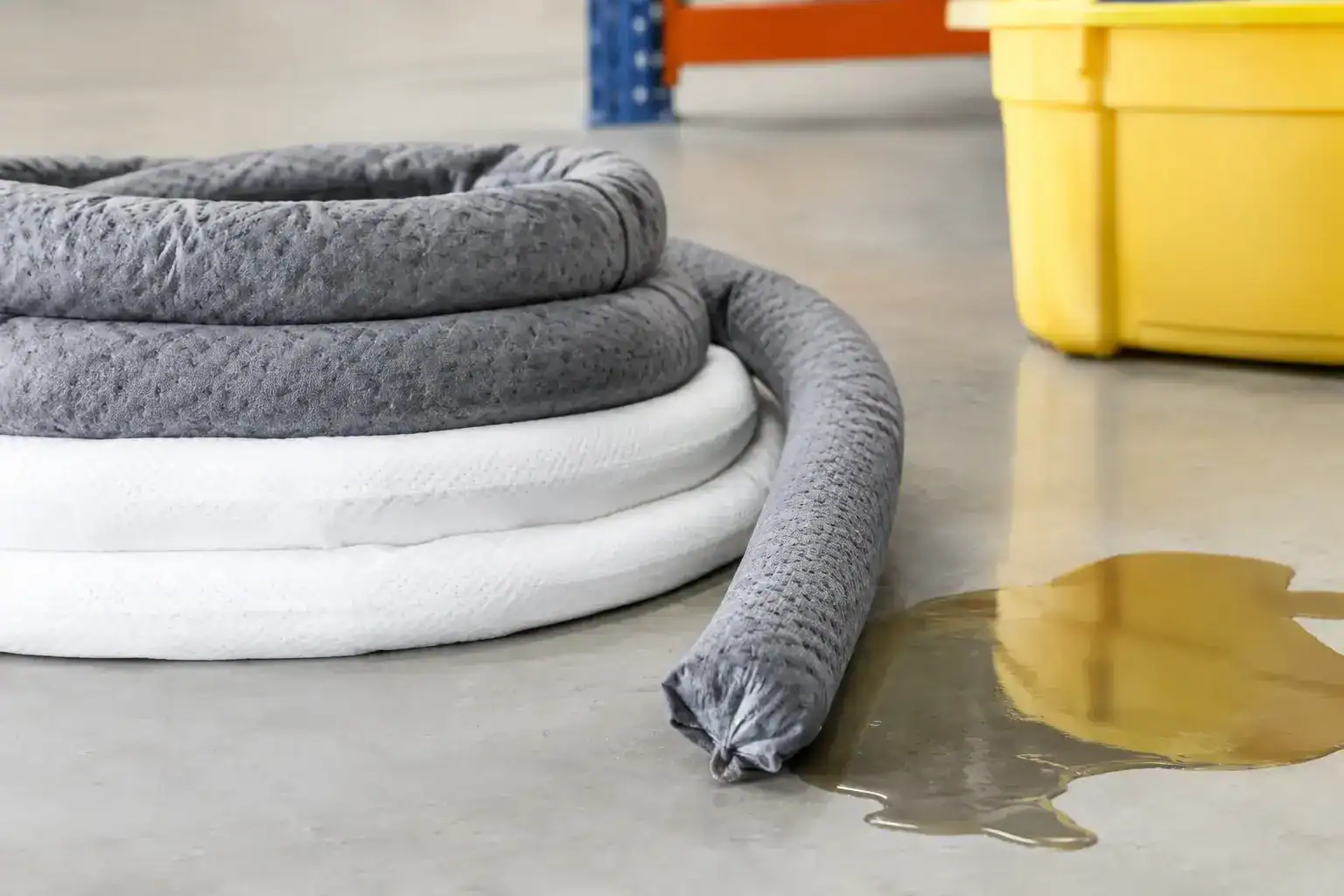
A leaking drum rarely waits for a spill kit to be unpacked. Once liquid reaches a door, drain, workshop bay or warehouse aisle, the first priority is to stop it travelling. Absorbent socks are designed for that job. Knowing how to select absorbent socks means matching the sock material, size and absorbency to the liquid and the route it could take across your site.
They are a practical first-response item, but they are not interchangeable. A universal sock placed around a small coolant leak may be suitable. The same product may be the wrong choice for hydrocarbons on water or for a strong chemical spill. Correct selection improves containment, reduces clean-up time and helps keep spill response arrangements fit for the hazards on site.
Start with the liquid being controlled
The liquid determines the absorbent category. Before ordering, identify what could spill in the area, not just what is stored there. Consider decanted fluids, waste containers, machinery oils, wash-down chemicals and deliveries as well as bulk stock.
General-purpose socks for mixed workplace liquids
General-purpose, often called universal, absorbent socks are commonly used in workshops, warehouses and maintenance areas where the likely spill is oil, coolant, water-based liquid or a non-aggressive chemical. They are suited to routine housekeeping and first response where several compatible liquids may be present.
Their flexibility makes them useful around equipment, along pallet racking and at the edge of work zones. However, “general-purpose” does not mean appropriate for every substance. Check the safety data sheet and the absorbent product specifications where corrosive, reactive or unknown liquids are involved.
Oil-only socks for hydrocarbons and marine use
Oil-only absorbent socks are made to absorb oils and fuels while repelling water. This makes them the appropriate choice for diesel, petrol, hydraulic oil and lubricants near stormwater, waterways, marinas and wet ground.
For a fuel spill on water, an oil-only sock can contain and absorb the hydrocarbon without becoming saturated with water. A general-purpose sock would absorb water as well, reducing its effective capacity and creating unnecessary contaminated waste. For outdoor fuel-handling areas, that distinction matters.
Chemical socks for hazardous liquids
Chemical absorbent socks are intended for aggressive chemicals, including acids, caustics and other hazardous liquids, subject to product compatibility. They should be selected where a universal product is not suitable for the chemical hazard present.
Do not rely on colour alone. While chemical absorbents are often visibly distinct for fast identification, the chemical compatibility information is the deciding factor. Review the safety data sheet, confirm the product’s stated application and make sure the spill response plan addresses required personal protective equipment and disposal arrangements.
Select the right length and diameter
Absorbent socks work by forming a physical barrier that follows the path of the spill. A sock that is too short leaves gaps. One that is too narrow can be overwhelmed before the leak is stopped. Measure the likely containment line before selecting a product.
Longer socks suit doorways, drain protection, warehouse aisles, loading zones and the perimeter of a larger spill. Shorter socks are more useful for wrapping around leaking machinery, placing beneath fittings or building a tight barrier around a small container. Many sites benefit from holding both sizes, rather than trying to make one format suit every response.
Diameter affects capacity and containment height. A larger-diameter sock generally holds more liquid and creates a more substantial barrier, but it can be less convenient in confined spaces. A slim sock can be shaped closely around a pump, drum or cabinet, yet may need to be doubled up where a higher volume of liquid is expected.
For a spill moving across a sloped concrete floor, use enough socks to create a continuous, overlapping line. If the liquid is travelling quickly, place a second line behind the first. This gives the response team more time to stop the source and add pads or granules inside the contained area.
Check absorbency, not just the pack quantity
Pack count is not a reliable measure of spill response capacity. Two packs may contain the same number of socks but have different lengths, diameters and total absorbency. Review the stated capacity and assess it against realistic spill scenarios at your site.
Start with the credible volume, not the largest tank on the premises. A small hydraulic hose failure, a 20-litre drum knocked over during decanting, or a leaking waste-oil container may be more likely than a full bulk-storage release. Your stock should be sufficient to contain the initial spill while further controls are put in place.
Absorbency figures are useful for planning, but site conditions can reduce real-world performance. Socks may pick up water, dirt or debris; they may be placed after liquid has already spread; and a high-flow leak can saturate them faster than a static puddle. Allow a margin rather than purchasing to the exact theoretical capacity.
Consider where the sock will be deployed
The best product also depends on the surface, environment and spill pathway. In a workshop, socks may be used around machinery, at roller doors or along the edge of a service pit. At a warehouse, they can protect drains, isolate a damaged package and prevent a spill reaching stock or pedestrian areas.
Outside, the route to stormwater is usually the main concern. Keep suitable socks close to fuel bowsers, chemical transfer points, waste storage, loading docks and areas where plant is parked. Storage location matters as much as product selection. A sock kept in a distant storeroom is of little use when liquid is already entering a drain.
For drains, a sock is often part of the response rather than the sole control. Use it to divert or surround flowing liquid, then apply appropriate drain covers, pads or other containment equipment as required. Sites with a repeated risk at a particular drain or doorway should consider permanent physical controls alongside spill-response stock.
Build socks into the wider spill response setup
Absorbent socks are containment tools. They generally do not replace pads, pillows, booms, drain covers, gloves or disposal bags. A practical spill kit combines products so workers can isolate the source, stop the spread, recover the liquid and manage contaminated materials safely.
For example, a leaking hydraulic fitting may require a sock around the equipment, pads beneath the leak, gloves suited to the fluid and a disposal bag for used absorbents. A diesel spill near a stormwater inlet may require oil-only socks, oil-only pads and drain protection. The selection should reflect the task sequence, not simply the first item used.
Make sure the kit is clearly marked for its intended spill type and located where the hazard exists. A chemical kit and an oil-only kit should not be treated as identical resources. Clear labelling reduces hesitation during an incident and helps workers choose the correct materials under pressure.
Confirm compatibility with PPE and disposal procedures
Absorbent socks become contaminated waste once deployed. The disposal method depends on the absorbed substance, site procedures and applicable waste requirements. Used oil-only socks may contain flammable hydrocarbons. Chemical socks can carry corrosive or toxic residues. Do not dispose of them as general rubbish unless the material and local requirements clearly allow it.
Workers must also have suitable PPE before approaching a spill. Gloves, eye protection, protective clothing and respiratory protection may be necessary depending on the substance and exposure risk. The sock may contain the liquid, but it does not make a hazardous spill safe to handle without the right controls.
Review the safety data sheet for the substance, follow workplace procedures and use a licensed waste provider where required. If a spill involves an unknown chemical, a significant volume, fire risk, vapour hazard or entry to drains or waterways, escalate according to the emergency plan rather than relying on absorbents alone.
A practical purchasing check
Before purchasing absorbent socks, confirm the liquid category, likely spill volume, location of use and the route the spill could take. Then check the stated compatibility, dimensions, total absorbency and number of socks needed to make a continuous barrier. Finally, ensure the relevant kit also contains the recovery materials, PPE and disposal supplies workers will need.
For many worksites, keeping a mix of general-purpose and oil-only socks provides useful day-to-day coverage, while chemical-specific stock should be held wherever hazardous chemicals are stored or handled. Spillmaster can help buyers source the right absorbent category for routine response and site-specific hazards.
A sock is a relatively simple item, but its value is measured in the seconds before a spill reaches a drain, doorway or waterway. Put the correct type within reach of the risk, and train staff to use it before the incident happens.