Choosing an Oil Spill Kit for Warehouse Use

A leaking drum in a warehouse rarely stays a small problem for long. Oil tracks under forklifts, spreads into walkways, and turns a routine shift into a slip hazard, cleanup job, and compliance risk. That is why an oil spill kit for warehouse operations should be selected with the same care as any other safety-critical equipment.
The right kit is not just about having absorbent pads on hand. It is about matching the spill response equipment to the oils you store, the way your warehouse runs, and the level of risk across loading areas, racking, battery charging zones, maintenance spaces, and dispatch points. For the broader process of matching kit type and size to workplace risk, see How to Select a Spill Kit. Buy too small, and you run out of absorbent when you need it most. Buy too large without a clear placement plan, and the kit may sit too far from the spill to be useful.
Why a warehouse needs a dedicated oil spill kit
Warehouses create a specific spill profile. You may be handling lubricants, hydraulic fluids, diesel, engine oils, or other petroleum-based liquids in drums, IBCs, machinery, forklifts, or service areas. Those products do not behave like water-based spills, and a general-purpose kit is not always the best fit.
An oil spill kit for warehouse use is designed to absorb hydrocarbons while helping teams control spread quickly. In practical terms, that means faster containment around pallet storage, less contamination of surrounding stock, and a safer cleanup process for staff working around moving equipment.
There is also a compliance angle. A spill that reaches a drain, loading dock edge, or external traffic area can create environmental exposure beyond the warehouse floor. Even a relatively minor leak can become reportable depending on the substance, volume, and site controls in place. Having the right kit available supports a more defensible response.
What should be in an oil spill kit for warehouse response
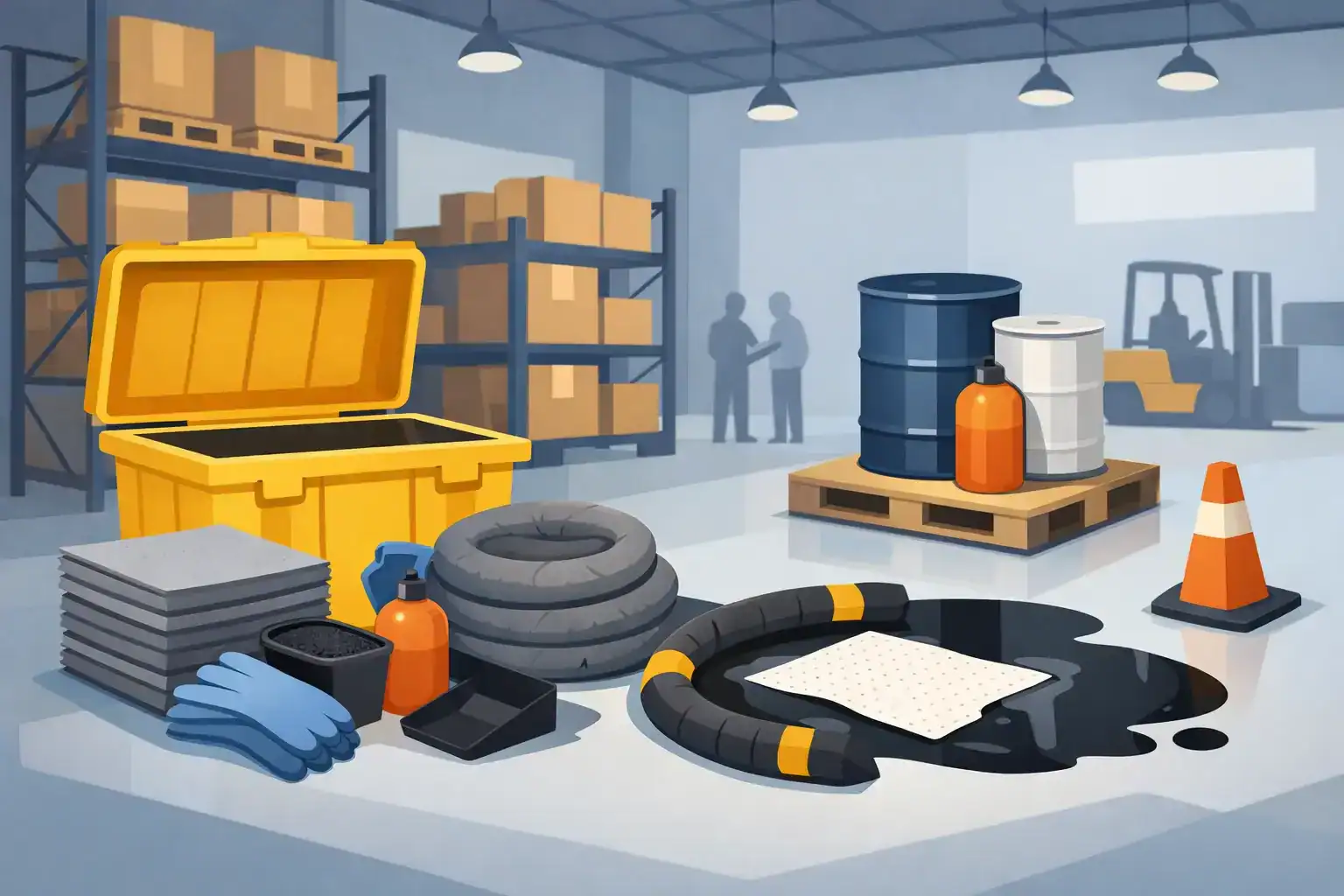
At minimum, the kit should include absorbent pads for pickup, absorbent socks or booms for containment, disposal bags, and basic PPE suited to the product handled. In higher-risk warehouses, you may also need heavier absorbents, drain protection, chemical-resistant gloves, or additional waste handling materials.
The absorbent type matters. Oil-only absorbents are built to take up oil and fuel while repelling water, which makes them useful in mixed indoor-outdoor environments or near roller doors where rainwater may be present. If your warehouse only deals with petroleum products in dry internal areas, they still make sense because they target the actual spill risk without wasting absorbent capacity on water.
PPE should not be treated as an afterthought. If the spill response requires staff to kneel, lift saturated socks, or bag contaminated waste, gloves and eye protection become part of the kit’s real usability. A kit that looks complete on paper but leaves workers hunting for PPE is not properly ready.
Sizing the kit to your actual risk
This is where many purchasing decisions go wrong. Buyers often choose based on price or standard kit size rather than the largest credible spill at the point of use.
Start with the containers and equipment in the warehouse. If you store only small oil containers for maintenance, a compact spill kit may be enough near that area. If you hold multiple drums, decant liquids, or operate forklifts and plant with hydraulic systems, the risk profile changes. A ruptured hose or damaged drum can release far more product than a small kit can manage.
You should also consider spread, not just volume. On sealed warehouse floors, oil can travel quickly, especially on smooth concrete with traffic movement. A 80 litre release near an active aisle may require more containment material than the same spill in a quiet corner because the priority is stopping migration before vehicles carry it further.
In many facilities, one large central kit and several smaller satellite kits work better than relying on a single unit. The large kit handles major events, while smaller kits support fast first response in higher-risk zones. It depends on site size, travel distance, and staffing patterns.
Where to place an oil spill kit in a warehouse
A well-stocked kit is only useful if people can reach it fast. Placement should reflect where spills are most likely to happen, not where there happens to be spare wall space.
Loading docks are a common priority because product moves in and out, drums get shifted, and leaks are often discovered there first. Maintenance areas are another obvious location, especially where oils are transferred or equipment is serviced. Battery charging and forklift service zones may also need nearby response equipment if hydraulic or lubricating oils are present.
For larger sites, it is worth thinking in response time rather than square footage. If a spill starts in an aisle at the far end of the warehouse, how long does it take for a team member to get the kit and return? If the answer is several minutes with forklift traffic in between, that area may need a dedicated unit.
Visibility matters too. Kits should be clearly marked, unobstructed, and included in site inductions and emergency response procedures. Hidden equipment tends to be forgotten until the worst time.
Oil-only vs general-purpose kits
Some warehouses try to standardize around one spill kit type for simplicity. That can work in low-complexity sites, but it is not always the best operational choice.
If the warehouse mainly handles oils, fuels, and hydrocarbon-based liquids, an oil-specific kit is usually the cleaner decision. It aligns the absorbents to the most likely spill type and avoids ambiguity during response. Workers do not need to stop and work out whether the yellow, gray, or other kit is appropriate if the spill source is clearly oil-based.
If you store chemicals as well as oils, you may need more than one spill response category on site. That is where zoning becomes useful. Put oil spill kits where hydrocarbon risks are concentrated and chemical kits where corrosives or mixed hazardous substances are handled. The trade-off is slightly more complexity in purchasing and training, but the benefit is a more accurate response.
Don’t ignore disposal and replenishment
A spill kit is not a one-time purchase. Once used, it needs to be restocked quickly and correctly. That sounds obvious, but in many warehouses a partially used kit sits for weeks because nobody owns the replenishment process.
Assign responsibility in advance. Whether that sits with maintenance, EHS, or warehouse supervision, someone should check kits routinely, record usage, and reorder refills before stock runs low. This is especially important in sites with recurring nuisance leaks from mobile plant or stored containers.
Disposal should also be planned, not improvised. Used absorbents contaminated with oil may need to be bagged, labeled, stored temporarily, and removed in line with site waste procedures and local requirements. If teams do not know what happens after cleanup, spills take longer to resolve and contaminated waste is more likely to be mishandled.
Training makes the kit effective
The best oil spill kit for warehouse use is the one staff can use without hesitation. That requires simple training tied to real site conditions.
Teams should know how to identify the spill source, stop the leak if safe, contain the spread first, and only then begin full absorption and disposal. They should also know when a spill is beyond routine cleanup and needs escalation. That threshold may depend on volume, location, ignition risk, or whether the spill is moving toward drains or external areas.
Short, practical drills are usually more effective than long written instructions alone. Walk the team through where kits are located, what each component is for, and who to call if the spill involves a larger release or a mixed substance. A specialist supplier such as Spillmaster can support buyers by making kit selection clearer, but site readiness still comes down to internal procedures and training discipline.
What buyers should look for before purchasing
A good purchasing decision comes down to fit, not just kit volume. Check the absorbent type, the quantity and mix of pads and socks, the quality of the container or bag, and whether PPE and disposal items are included. Make sure refill availability is straightforward so the kit does not become a one-use asset.
Also consider how the kit will be stored and moved. In some warehouses, a wheeled bin-style kit makes more sense for larger response volumes. In tighter spaces, a compact bag or smaller station-based unit may be easier to position close to the hazard. Neither is automatically better. It depends on access, spill size, and whether one person can deploy it quickly.
Price matters, but failure costs more. A cheaper kit that lacks enough containment material, uses poor-quality absorbents, or is the wrong type for your liquids can create more downtime and risk than it saves.
The right oil spill kit for warehouse operations should match your hazards, your layout, and your response plan. If the kit is easy to find, correctly sized, properly stocked, and familiar to the team, it becomes what it should be from the start – a practical control that works when the floor is slick, the pressure is on, and time matters.Explore our full range of Spill Kits, Spill Control, PPE – Price Assured & Guaranteed at Spillmaster today.