Spill Berm Versus Containment Tray for Your Site

A spill berm versus containment tray decision usually comes down to one operational question: are you containing a fixed storage risk, or managing a spill risk that moves with vehicles, plant or changing work areas? Both products provide secondary containment, but they solve different problems. Selecting the wrong format can leave a site with equipment that is difficult to use, undersized for the task, or simply ignored when it is needed most.
For warehouses, workshops, fuel-handling areas and field operations, the right containment equipment needs to suit the liquid, the available space, traffic patterns and the way work is actually carried out. Capacity matters, but so do access, chemical compatibility and whether the unit can be deployed before a leak becomes a release.
Spill berm versus containment tray: the core difference
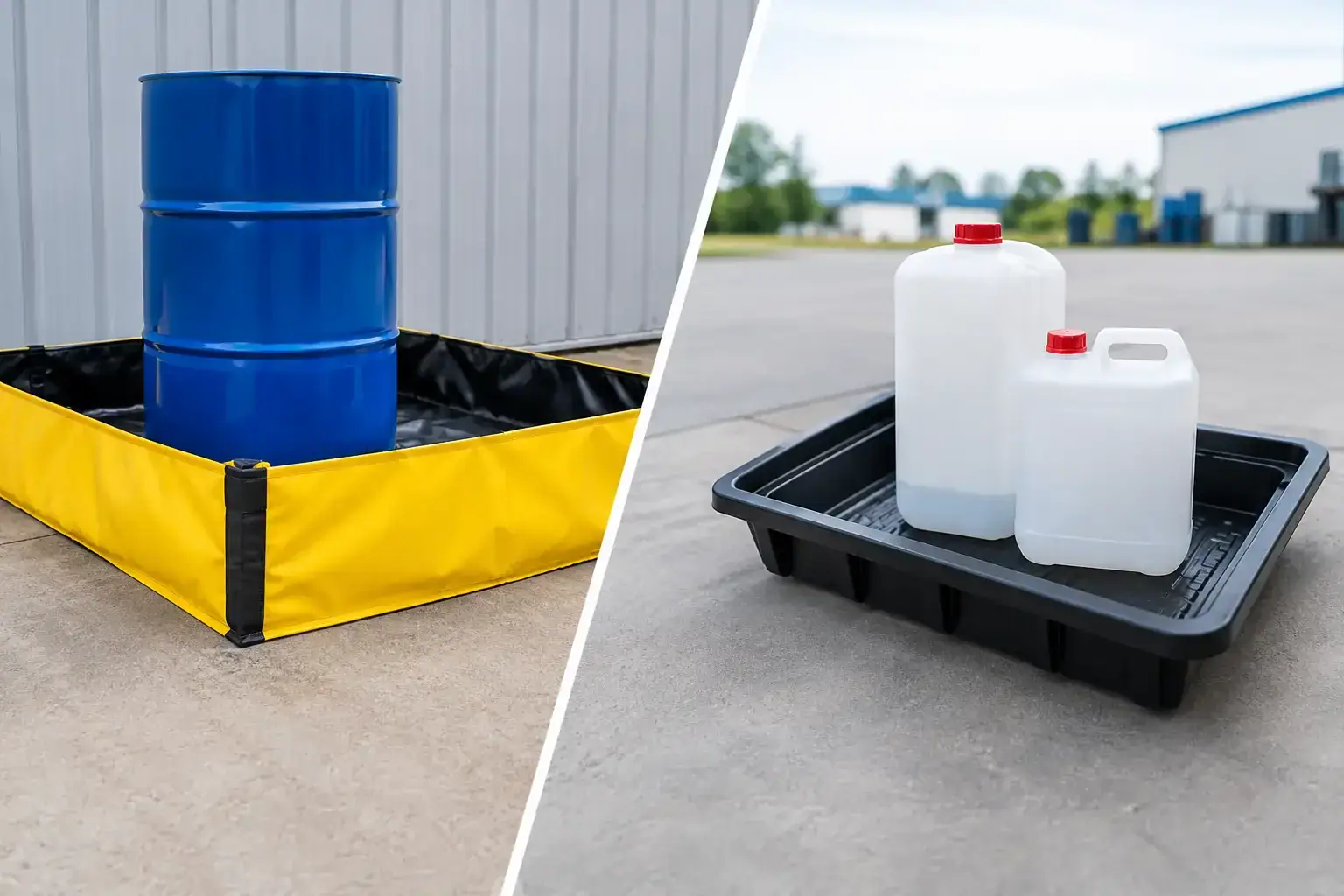
A containment tray is a rigid or semi-rigid bunded base designed for stationary containers and equipment. It is commonly used beneath drums, jerry cans, small chemical containers, pumps, batteries or waste-fluid vessels. The tray creates a defined collection area, helping prevent small leaks, drips and dispensing spills from reaching the floor, drains or surrounding work areas.
A spill berm is a larger containment area with raised walls, often made from flexible, chemical-resistant material. Many are portable or collapsible. Berms are typically used where vehicles, IBCs, plant, tanks or larger temporary storage arrangements need secondary containment. Some designs allow vehicles to drive over collapsible sidewalls, while others are installed around equipment or used as a temporary bunded work zone.
In simple terms, trays suit contained, static storage. Berms suit larger footprints, changing sites and equipment that needs access. There is overlap, but treating one as a substitute for the other can create practical limitations.
When a containment tray is the better fit
Containment trays are often the most efficient choice for routine storage and handling of smaller containers. A workshop storing oils, coolants, solvents or maintenance chemicals can place drums and decanting equipment within a tray, creating a clear and manageable spill-control point. The same approach works in a warehouse where containers are held temporarily before use or disposal.
Their main advantage is simplicity. A tray can be positioned under the source of likely drips and left in place. There are no walls to step over or set up before each job, which improves the chance that staff will use it consistently. For minor leaks, the tray keeps liquid visible and accessible for recovery with suitable absorbents.
Trays are also useful where floor space is limited. Low-profile designs can sit beneath shelving, benches or smaller packages, while larger bunded trays may accommodate several drums. For fixed applications, their firm base and defined shape make inspections straightforward.
However, a tray is not automatically suitable for every storage arrangement. A shallow tray may be adequate for drips during dispensing but not for the loss of a full container. A tray can also become impractical if equipment must be driven into it, moved frequently by forklift, or accessed from several sides. In those cases, a berm or purpose-designed spill pallet may be more appropriate.
When a spill berm makes more sense
Collapsible spill berms are designed for broader and more variable containment tasks. They are commonly used beneath vehicles during servicing, around mobile plant during refuelling, under temporary tanks, and in field locations where permanent bunding is unavailable. Their flexible construction makes them useful for shutdowns, maintenance work, site projects and remote operations.
A vehicle maintenance area is a typical example. If a truck, excavator or generator may leak oil, diesel, hydraulic fluid or coolant, a berm can provide a controlled work area around the asset. Rather than relying on absorbents after the fact, the liquid is held within the berm for recovery and correct disposal.
Berms are also valuable where the containment footprint must change. A flat-packed unit can be stored until required, then deployed for a specific task. That can reduce the need for permanent infrastructure at temporary work areas, although it does not remove the need to assess the job, liquid hazards and site requirements.
The trade-off is that berms require more planning. The ground needs to be reasonably level and free from sharp objects that could damage the liner. Staff need to know how to deploy the walls correctly and how vehicles will enter and exit without compromising containment. A berm full of rainwater, debris or accumulated liquid is not ready for an emergency.
Capacity is more than a product specification
The most common selection error is choosing containment based only on the physical footprint of containers. The key question is how much liquid the system may need to hold if a credible failure occurs. That will depend on the number and size of containers, whether transfers occur within the area, and the applicable site, environmental and dangerous goods requirements.
For example, a tray beneath several drums may need to contain more than routine drips if those drums are stored there continuously. A berm used for vehicle servicing needs enough capacity for the likely spill scenario, without allowing the vehicle to displace so much volume that containment is reduced below an acceptable level.
Do not assume the product’s stated capacity is the usable capacity in every configuration. Ramps, sidewall design, vehicle displacement, uneven ground and stored equipment can all reduce the available volume. Check product dimensions and capacity carefully, then allow a practical margin rather than selecting to the absolute limit.
Match the material to the liquid
Secondary containment is only effective if its construction is compatible with the materials being handled. Oils, fuels, coolants and many common workshop liquids may have different requirements from aggressive acids, alkalis, solvents or oxidisers. A tray or berm that performs well with hydrocarbons may not be suitable for all chemicals.
Review the safety data sheet for each liquid and confirm compatibility with the containment material before purchase. Consider what else may enter the area, including wash-down water, rainwater in outdoor locations and residue from previous tasks. Mixed liquids can complicate recovery and disposal, particularly where hazardous waste is involved.
UV exposure is another factor for outdoor applications. A portable berm that is regularly exposed to sun, vehicle traffic and rough surfaces will have different service demands from a tray positioned inside a clean store. Inspection should be part of normal housekeeping, not something saved for an incident.
Consider access and daily behaviour
Containment equipment needs to work with the job, not against it. If staff have to lift heavy drums over a high wall, they may bypass the containment area. If a forklift cannot safely place a pallet within a tray, the tray may create handling risks. If a vehicle cannot enter a berm without damaging the wall, the arrangement needs a different design or suitable access method.
Before buying, map the normal movement of containers, people and plant through the area. Consider whether filling, decanting, maintenance or inspection occurs inside the containment zone. Confirm that emergency access, aisles and evacuation paths remain clear.
For fixed drum storage, a spill pallet may be more appropriate than either a basic tray or flexible berm, particularly where drums are handled by forklift. For small-scale dispensing, a compact tray paired with suitable absorbents may be all that is required. For mobile maintenance or temporary fuel handling, a berm is often the more practical choice.
A practical selection check
Use these questions before specifying a spill berm or containment tray:
- What liquid could be released, and is the containment material compatible with it?
- Is the risk from static containers, decanting, vehicle servicing or temporary plant?
- What is the credible spill volume, including displacement from stored equipment or vehicles?
- Will forklifts, vehicles or personnel need to enter the containment area?
- Is the location indoors, exposed to weather, or likely to be moved between work areas?
These answers generally make the product category clear. They also help procurement teams avoid buying containment based on price alone, only to find it is too small, too shallow or unsuitable for the worksite.
Set up the containment system properly
A tray or berm is part of a wider spill-control system. Keep appropriate absorbents, drain protection and spill response equipment nearby, based on the materials present. Train relevant staff to identify leaks, stop work where safe, prevent spread and report the incident under site procedures.
Inspect containment routinely for cracks, punctures, deformation, chemical attack and accumulated liquid. Remove collected rainwater only where it is confirmed uncontaminated and can be managed in accordance with site procedures. Any recovered hazardous liquid, used absorbent or contaminated debris should be handled as waste through the correct process.
For buyers comparing options, the strongest choice is rarely the largest unit or the lowest-cost unit. It is the containment solution that matches the likely spill, fits the way your team works and can be kept ready for use. That is how a spill berm or containment tray becomes practical protection rather than equipment sitting unused in the store.