Best Drum Storage Accessories for Safer Sites

A 205 L drum is manageable only while it stays sealed, upright and contained. Once it is exposed to forklift traffic, weather, dispensing tasks or a busy workshop floor, the risk changes quickly. The best drum storage accessories are the practical controls that keep leaks contained, prevent incompatible handling and make routine access safer for workers.
For warehouses, workshops, fuel-handling areas and industrial sites, accessories should not be treated as optional extras. The right combination supports orderly storage, reduces clean-up time and helps maintain a safer response position if a drum leaks or is damaged.
Start with the storage risk, not the accessory
A drum accessory is only useful when it suits the substance, container and task. Oil, diesel, corrosive chemicals, solvents and waste liquids have different compatibility, ignition and containment requirements. The product Safety Data Sheet, your site risk assessment and relevant WHS and dangerous goods obligations should guide the selection.
Consider how many drums are stored, whether they are full or partly used, how they are moved, and whether staff dispense product from them. A covered outdoor drum store has different needs from an indoor flammable-liquid decanting point. Likewise, a bund that works for four standard 205 L drums may not suit smaller drums, irregular containers or a location requiring forklift access.
The aim is straightforward: prevent a release where possible, contain it if it occurs, and ensure workers can handle the drum without creating another hazard.
Best drum storage accessories for containment
Drum bunds and spill pallets
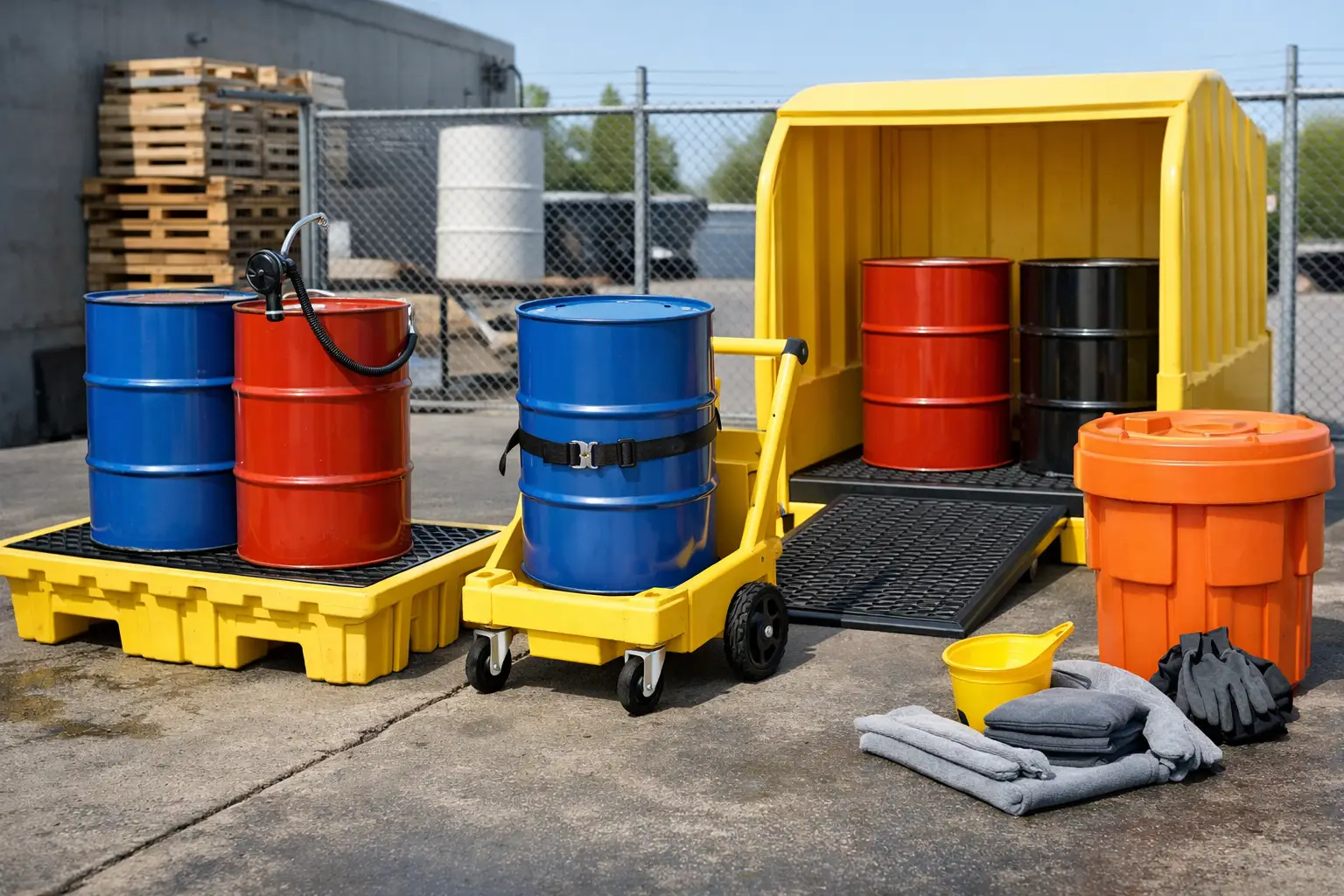
Secondary containment is the foundation of safe drum storage. Drum bunds and spill pallets capture leaks, drips and overfills before they reach floors, soil or stormwater drains. They are available in one-, two- and four-drum configurations, along with larger modular systems for higher-volume storage areas.
Choose a unit with sufficient sump capacity for the storage arrangement and liquid type. Check the material compatibility as well. Polyethylene bunding is commonly used for many oils, fuels and chemicals because it resists corrosion, while steel options may suit selected applications where mechanical strength or site conditions call for them. The suitability of any material must still be checked against the chemical being stored.
A removable grate makes it easier to keep drums above any captured liquid and allows basic inspection underneath. For forklift-serviced areas, consider whether the pallet can be loaded safely, whether a ramp is needed and how operators will access drums without damaging the bund wall.
Bunded work floors and modular bunding
Where a site stores more than a few drums, individual pallets can become inefficient. Modular bunding and bunded work floors create a defined containment area around multiple drums, IBCs or dispensing equipment. This can be a better approach where containers are routinely moved, staged or decanted.
The trade-off is planning. A larger bunded area requires clear access routes, reliable liquid management and a process for removing any collected spill material. It should not become a general storage zone where incompatible substances, empty containers and unrelated equipment accumulate.
Drain covers and drain protection
A drum leak becomes a more serious environmental incident when it reaches a drain. Drain covers, drain seals and other drain-protection products should be kept close to higher-risk drum stores, transfer points and loading areas. They are not a replacement for bunding, but they provide an immediate barrier if a spill escapes its primary containment.
Make sure staff know where these items are kept and when to use them. A drain cover stored in a locked cabinet at the other end of the facility will not help during the first minutes of a fuel or chemical release.
Accessories that make dispensing safer
Drum funnels and safety funnels
Many spills occur during transfer rather than storage. A properly fitted drum funnel helps direct liquid into the drum, reduces splash and captures small overfills. Models with hinged lids can also limit contamination from dust and rain when drums are stored outdoors.
For waste-oil collection, used solvent handling or frequent decanting, select a funnel designed for the drum opening and expected flow rate. An undersized funnel creates bottlenecks and encourages workers to rush. A poorly secured funnel can be knocked loose by a hose, container or passing equipment.
Drum taps, pumps and dispensing valves
A drum tap or pump allows controlled dispensing without tipping a heavy drum. This reduces manual-handling risk and can make it easier to measure smaller quantities. The fitting must match the drum bung thread, liquid viscosity and chemical compatibility requirements.
A basic gravity tap may suit low-viscosity oils and non-hazardous liquids. For corrosives, solvents or flammable liquids, the pump, seals and hose materials require more careful selection. Where flammable liquids are transferred, site controls may also require bonding and earthing arrangements to manage static electricity. Do not assume a standard tap is suitable simply because it fits the drum.
Position dispensing equipment within the bunded area and keep a suitable spill kit nearby. A drip tray under the outlet is useful for routine residue, but it does not replace adequate secondary containment for the drum itself.
Drum cradles and drum stands
Drum cradles and stands hold drums horizontally so product can be dispensed through a tap. They can improve access and reduce the temptation to roll or tilt drums by hand. However, they require a stable, level base and must be rated for the drum size and weight.
Horizontal storage changes the leak risk around bungs and fittings. Inspect valves, caps and connection points regularly, particularly where drums are subject to vibration, temperature changes or frequent use. Keep the cradle inside a suitable bund or spill pallet rather than treating the stand as containment.
Protection, access and housekeeping controls
Drum covers and weather protection
Outdoor storage exposes drums to rainwater, ultraviolet light, heat and debris. Drum covers help prevent rainwater collecting on lids, reduce corrosion on steel drums and keep dispensing points cleaner. They also help prevent contaminated water from entering an open funnel or damaged closure.
A cover is not permission to store any substance outdoors. Check whether the product is approved for external storage, whether the area needs security measures and whether heat or direct sunlight could affect the contents. Covers should be secured without blocking inspections or access during an emergency.
Ramps, trolleys and handling aids
Drum ramps help move drums on and off compatible spill pallets without lifting. Drum trolleys, lifters and handlers reduce the risks associated with rolling, carrying or manoeuvring heavy containers. These accessories are particularly useful where a single worker must move drums through a workshop or warehouse.
The key is matching the aid to the route. Check floor condition, doorway widths, gradients, turning space and forklift interaction. A trolley that is suitable on smooth concrete may be unsafe on uneven yards or grated surfaces.
Labels, signage and inspection tools
Clear labelling and signage are low-cost controls with a high practical value. Mark storage areas, identify hazardous substances, display relevant emergency information and ensure every drum remains identifiable. Unlabelled decanted liquids and faded container markings create avoidable compliance and response problems.
Inspection tags, checklists and a basic stock register also support safer storage. Regular checks should look for corrosion, bulging, damaged bungs, staining, drips, pooled liquid and blocked access to spill-response equipment.
Selecting drum storage accessories for your site
Before ordering, confirm the details that affect fit and compliance. A short purchasing check should cover:
- the liquid type, Safety Data Sheet requirements and material compatibility;
- drum quantity, size, full weight and expected storage duration;
- required containment capacity and whether the area is indoors or outdoors;
- dispensing, pumping and transfer tasks carried out by workers; and
- access requirements for forklifts, trolleys, inspections and emergency response.
It is also worth separating clean product storage from waste-liquid storage. Waste drums can have uncertain contents, damaged labels or higher transfer frequency, so they often require more conservative containment and clearer inspection controls. Incompatible materials should never share a bund merely because there is available space.
Price matters, but the lowest-cost accessory can become expensive if it does not fit the drum, degrades under chemical exposure or creates slow, awkward handling. Fit-for-purpose equipment is easier for workers to use correctly, which is where its safety value is realised.
A well-managed drum area should let a supervisor see, at a glance, what is stored, whether it is contained and whether staff can respond quickly to a leak. Set up the accessories around that standard, then inspect the area often enough to catch small failures before they become a reportable spill.