Granules Versus Absorbent Pads for Spill Control

A leaking drum does not wait for the right delivery day or a convenient maintenance window. The material chosen for first response affects how quickly a spill is contained, how cleanly it is recovered and how much contaminated waste is left behind. When comparing granules versus absorbent pads, the right answer depends on the liquid, spill location, surface condition and the way your team needs to work.
Granules and pads are both core spill-response consumables, but they do different jobs well. A site that carries only one type may be adequately equipped for a minor workshop leak yet poorly prepared for a fuel spill near a drain, an oil release beneath machinery or a chemical decanting incident. Selecting by application, rather than unit price alone, is the more reliable approach.
Granules versus absorbent pads: the practical difference
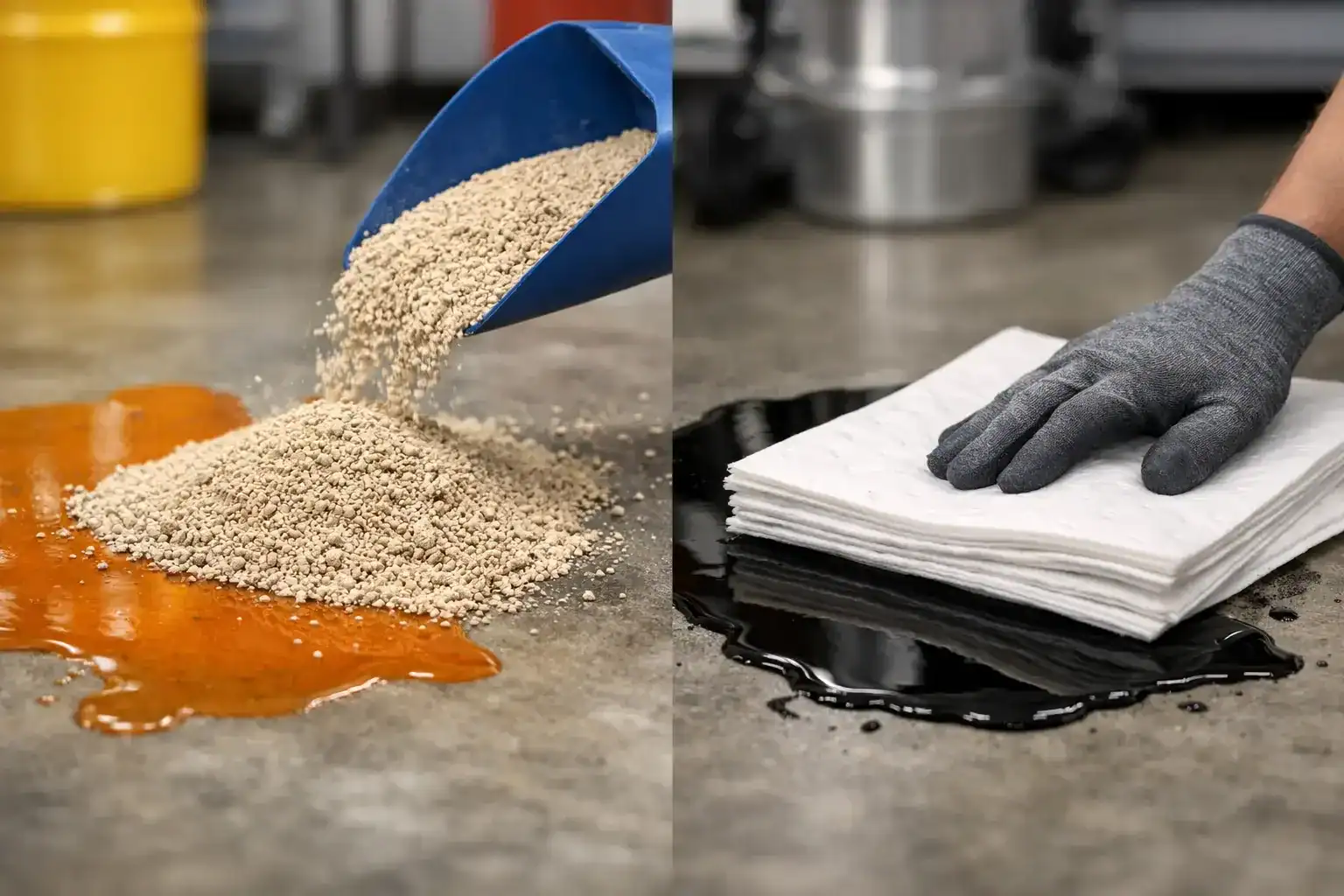
Absorbent granules are loose particulate materials spread directly over a spill. They are commonly used on concrete, sealed hardstands and workshop floors where liquid needs to be quickly taken up and swept away. Depending on the product, granules may be mineral-based or made from other absorbent materials. Their key advantage is that they can conform to uneven surfaces, cracks and textured concrete where a flat pad cannot maintain full contact.
Absorbent pads are sheets designed to draw in liquid from the surface beneath them. They are available in different absorbency ratings and formats, including oil-only pads, general-purpose pads and chemical absorbent pads. Pads provide controlled coverage, are easy to place precisely and generally produce a more manageable waste stream than loose material.
Neither option replaces the need to stop the source, protect drains and use appropriate personal protective equipment. Absorbents are a response measure, not a substitute for sound storage, bunding and maintenance controls.
When granules are the better choice
Granules are often the practical option for spills on damaged, rough or irregular ground. A workshop floor with expansion joints, a concrete loading area or a hardstand with a rough finish can leave liquid sitting in low points. Spreading granules over the affected area allows the material to settle into these imperfections and absorb residue that pads may bridge over.
They can also be useful for small, localised drips beneath plant or vehicles, particularly when workers need to treat a contaminated patch before it becomes a slip hazard. Once the specified contact time has passed, the saturated material can be swept up using dedicated spill-response tools and placed in suitable waste packaging.
The trade-off is control. Loose granules can be kicked or blown beyond the spill area. In windy outdoor locations, near stormwater drains or around moving traffic, this creates a secondary housekeeping problem. Fine particles can also make a wet surface less stable before absorption is complete, so workers should avoid walking through treated areas and follow the product instructions.
Granules are not automatically suitable for every hazardous liquid. Compatibility matters. A product suitable for oils may not be suitable for corrosives, oxidisers or unknown substances. Check the safety data sheet, site procedure and absorbent product guidance before use. If a spill involves an incompatible, reactive or unidentified chemical, isolate the area and escalate under the site emergency plan rather than relying on a general clean-up method.
Where absorbent pads perform best
Pads are usually the cleaner, more controlled choice for smooth floors, benches, beneath machinery and inside spill kits. They can be laid directly over a spill or positioned under known leak points as a preventative measure. A maintenance team dealing with hydraulic oil beneath a press, for example, can place pads under the leak, replace them as required and keep the surrounding work area clearer than it would be with loose granules.
For oil and fuel applications, oil-only pads are designed to absorb hydrocarbons while repelling water. This makes them particularly useful around wet areas, marine operations, wash bays and outdoor equipment where rainwater or surface water is present. They should not be treated as a universal chemical solution. For acids, caustics and other hazardous chemicals, use chemical absorbent pads matched to the material involved.
Pads are also well suited to protecting drains after the source has been controlled. They can be placed around the spill perimeter to intercept migration across a smooth surface, although drain covers, booms or other containment equipment may be required where there is a realistic risk of liquid entering stormwater. A pad alone should not be relied on as a drain-protection device during a larger release.
Because pads remain in a defined area, they are generally easier to count, bag and dispose of. This can simplify post-incident housekeeping and help supervisors assess how much contaminated waste has been generated. Their limitation is surface contact. On heavily cracked concrete or gravel, liquid can travel below or around a pad, leaving contamination behind.
Match the absorbent to the spill, not the shelf
The first decision is the liquid. Oil-only absorbents are intended for hydrocarbons such as diesel, petrol, lubricating oil and hydraulic fluid. General-purpose absorbents are commonly used for non-aggressive workplace liquids, including coolants, water-based fluids and some oils. Chemical absorbents are selected for hazardous chemicals, but suitability must still be confirmed against the substance being handled.
The second decision is the setting. Indoors, pads often allow fast, tidy response on sealed surfaces. Outdoors, wind, rain, traffic and drainage pathways change the risk. Granules may suit rough hardstands away from drains, while oil-only pads and booms can be more effective near water or where hydrocarbon containment is needed without absorbing rainwater.
Finally, consider spill size and response time. Pads are efficient for early intervention, small leaks and defined releases. Granules can cover a wider, irregular patch but may take longer to spread, work through and sweep up. For a significant spill, neither material should be scattered without first establishing perimeter control and protecting nearby drains.
Waste, compliance and stock control
Once an absorbent has contacted a hazardous substance, it must be handled as contaminated waste. The original liquid determines the disposal requirements, not whether the response material was a pad or a granule. Keep waste contained, labelled where required and managed in accordance with the safety data sheet, local requirements and your approved waste contractor’s directions.
This is one reason to avoid over-applying absorbent material. Using far more than the spill requires increases waste volume and disposal cost. Use enough pads or granules to capture the liquid fully, then inspect the area for residue. A final wipe-down or additional pad may be needed after granules have been removed, especially on smooth surfaces where fine residue remains.
Stocking should reflect real site risks. A warehouse with forklifts and hydraulic equipment may need general-purpose pads for routine leaks, with granules available for rough loading areas. A fuel-handling operation needs oil-only materials, drain protection and appropriate containment equipment. Chemical stores require absorbents selected for the substances held on site, supported by clear response instructions and accessible PPE.
Keep materials close to likely spill points, not locked in a distant store room. Inspect spill kits and loose consumables routinely, replace used stock promptly and make sure workers know which colour-coded absorbent is intended for each application. The best product cannot help if it is unavailable, incorrectly selected or used after liquid has already reached a drain.
A practical purchasing decision
Choose granules when the spill is on uneven hard ground and the product is compatible with the liquid. Choose pads when you need clean, targeted absorption on smooth surfaces, under equipment or around controlled work areas. For many workplaces, the sensible answer is not granules or pads. It is both, supported by spill kits, drain protection and a response plan that matches the hazards present.
A well-stocked response point gives workers a straightforward choice under pressure: contain the liquid, use the compatible absorbent, recover the waste and report the incident. That preparation protects people, keeps the site operational and gives your team a better chance of stopping a small release before it becomes an environmental or compliance issue.