Chemical Compatibility Storage Guide for Worksites


A chemical store can look orderly and still present a serious incident risk. Drums, jerry cans and bottles do not become compatible because they are neatly labelled or sit on the same pallet. This chemical compatibility storage guide sets out a practical method for deciding what can be stored together, what must be separated, and what containment equipment is required to manage a leak safely.
The objective is not simply to meet a storage checklist. It is to prevent incompatible substances from mixing during normal use, a damaged container, a fire or a spill. A small leak from the wrong container can generate heat, toxic gas, fire, pressure or a difficult clean-up.
Start with the substance, not the container
Every chemical storage decision should begin with the current Safety Data Sheet (SDS). The SDS identifies the product hazards, dangerous goods classification where applicable, incompatible materials, storage conditions and spill response requirements. Product labels and supplier information should support the SDS, but should not replace it.
Dangerous goods classes are useful for initial segregation, but they are not a complete compatibility assessment. Two products in the same class may have different incompatibilities. Likewise, a product that is not classified as dangerous goods may still react with another material or create an environmental hazard if released.
For each chemical, record its product name, maximum quantity on site, container type, storage temperature requirements, dangerous goods class and subsidiary risks, and the specific incompatibilities listed in the SDS. Review this register whenever a new product is introduced, a supplier changes formulation, or storage quantities increase.
Identify the incompatible pairs first
Some separation requirements are well understood, yet are regularly compromised when space is tight. Acids and alkalis should generally be segregated because a leak can react violently and create heat or splashing. Oxidising agents must be kept away from flammable liquids, fuels, oils, paper, timber and other combustible materials because they can intensify a fire.
Flammable liquids need dedicated storage away from ignition sources, oxidisers and reactive chemicals. Corrosives require containers and shelving that resist attack by the chemical being stored. Cyanides and sulphides demand particular care around acids, as contact can release highly toxic gases. Water-reactive products must be protected from water, aqueous absorbents and sprinkler discharge where their SDS identifies that risk.
Do not rely on a rule such as “all chemicals go in the chemical cabinet”. Compatibility depends on the actual substances, their quantities and the consequence if containers fail at the same time. When the SDS is unclear or products have complex reactive properties, seek competent technical advice before co-locating them.
Use separation that works during a spill
A gap on a shelf is not always effective segregation. If containers can leak into the same bund, sump or drain path, the substances may still mix. The separation method needs to account for the credible spill volume, the container height, site traffic and how liquids would travel across the floor.
Physical distance can be suitable for smaller quantities where a spill cannot cross between storage areas. For higher-risk combinations, use a solid barrier, separate cabinets or separate bunded storage areas. Separate spill pallets or modular bunding may be needed where drums and IBCs are stored outdoors or in a warehouse.
A practical assessment should consider five questions:
- Could a leak from one container reach the other chemical?
- Could a forklift strike, falling load or earthquake damage both stores at once?
- Does the shared bund, drain or sump allow incompatible liquids to mix?
- Can firewater carry one product into another storage area?
- Can staff access the correct spill equipment without passing through the hazard?
These questions often expose problems that are missed by a simple shelf-by-shelf inspection.
Select cabinets, bunding and shelving for the hazard
Storage equipment must be chemically compatible with the materials it contains. A cabinet or spill pallet that is suitable for oils and fuels may not be suitable for strong acids, caustics or oxidising agents. Check the construction materials, sump design, shelf load rating and chemical-resistance information before purchase.
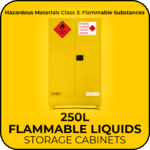
Flammable liquids storage cabinets are designed to control the fire risk associated with flammable liquids in packaged containers. They should be selected and positioned in line with the relevant SDS requirements, site fire controls and applicable Australian standards. Do not use a flammable liquids cabinet as a general-purpose chemical cupboard for oxidisers, corrosives or poisons unless the manufacturer and chemical compatibility assessment confirm that arrangement is appropriate.
For corrosive liquids, use corrosion-resistant cabinets, trays and bunding. Ensure shelves will not degrade, soften or crack if the stored product leaks. Secondary containment should have enough capacity for the likely release, while also preventing rainwater accumulation in outdoor applications. A full sump can defeat the purpose of bunding and may turn a minor leak into an overflow.
Shelving also matters. Store heavy containers low, keep caps secured, protect containers from vehicle impact and avoid overhanging shelves where a leak can fall onto incompatible products below. Decanting stations need their own local containment and should not be set up in a busy aisle simply because there is spare bench space.
Build a chemical compatibility storage layout
A workable layout starts by grouping chemicals by hazard and compatibility, then assigning a defined location to each group. Mark storage zones clearly so operators can identify where a chemical belongs before they put it down. If there is uncertainty, quarantine the container rather than placing it in the nearest available space.
Keep incompatible groups out of the same cabinet, cage or bunded zone where required by the SDS or risk assessment. Maintain access for inspections and emergency response. Storage areas should also be protected from heat, direct sunlight where relevant, stormwater entry and unauthorised access.
Consider the route chemicals take through the site. A well-designed store can still be undermined if corrosives are transported through the flammable goods area, or if delivery drivers leave new drums in an unbunded receiving bay. Establish a receiving process that checks labels, container condition and assigned storage location before stock is put away.
For mixed dangerous goods stores, the assessment should align with applicable Australian requirements, including relevant Australian Standards and local fire authority or WHS obligations. Requirements can vary with the class, quantity, packaging group, location and whether materials are stored indoors or outdoors. Treat the SDS and site-specific risk assessment as the operational starting point.
Match spill response equipment to the store
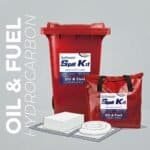
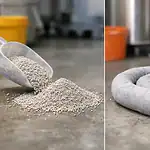
Segregation reduces the chance of a reaction, but it does not remove the need to respond to leaks quickly. Position spill kits close enough to be useful without placing responders in immediate danger. The absorbent type must suit the liquid involved. General-purpose absorbents are commonly used for oils, coolants and non-aggressive liquids, while chemical absorbents are intended for a broader range of hazardous liquids.
Do not assume any absorbent can be used on any chemical. Water-reactive chemicals, strong oxidisers and unknown products may require a specific response set out in the SDS. Ensure staff know when to contain a spill and when to isolate the area, raise the alarm and call for specialist assistance.
Drain protection, compatible overpacks, recovery containers and suitable personal protective equipment should be considered alongside absorbents. The PPE stated in the SDS is the minimum reference point. Gloves, eyewear and protective clothing must be compatible with the chemical and the task, not simply available in the store.
Inspect, train and revise
Chemical compatibility is not a one-time storage project. Inspect stores routinely for damaged containers, faded labels, corroded shelves, blocked access, full sumps and chemicals placed in the wrong zone. Check expiry dates where relevant and remove obsolete stock before it becomes an unidentified disposal problem.
Train employees who receive, use or store chemicals. They should understand the site labelling system, know where to find SDSs, recognise incompatible storage groups and report damaged containers immediately. A clear process is more reliable than expecting every worker to memorise every reaction risk.
Spillmaster supplies practical containment, storage and spill response equipment for work sites that need fit-for-purpose safety controls. The right equipment supports a sound storage plan, but it cannot correct a poor compatibility decision.
The most useful final check is simple: if two containers leaked at the same time, would your current layout keep their contents apart? If the answer is uncertain, separate them before the uncertainty becomes an incident.