Dangerous Goods Segregation Guide for Worksites

A dangerous goods segregation guide is not a substitute for reading labels or Safety Data Sheets, but it gives your team a practical way to prevent a small storage mistake becoming a fire, toxic release or costly clean-up. In a warehouse, workshop, depot or plant room, the risk often comes from products stored close together because there was space available, not because they were compatible.
Segregation means keeping dangerous goods apart when a leak, spill, fire or other incident could cause them to react. The right arrangement protects people, stock, drainage and neighbouring properties. It also makes emergency response more controlled when things do go wrong.
What dangerous goods segregation is designed to prevent
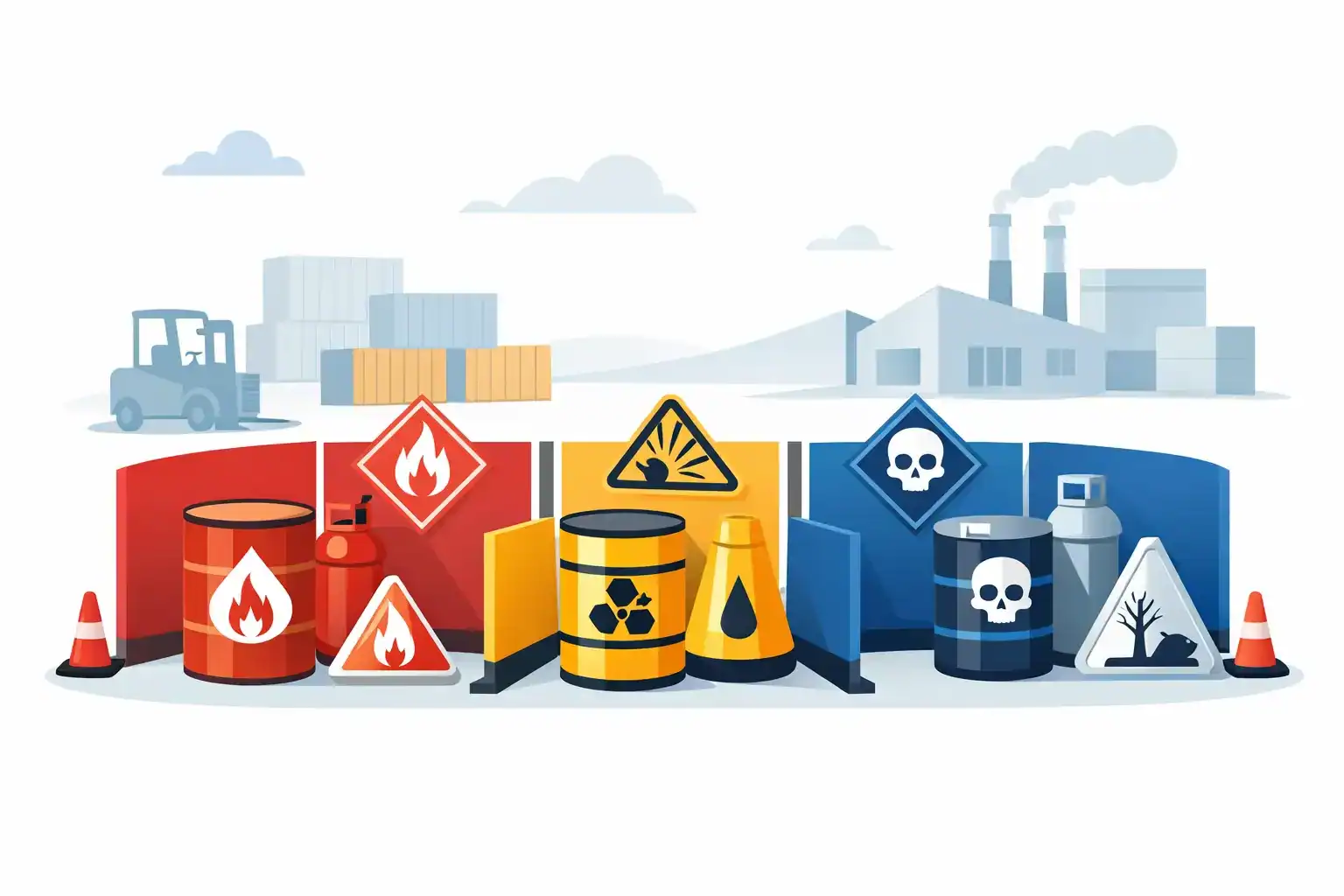
Dangerous goods can create a much greater hazard when incompatible materials meet. Acids and alkalis may react violently. Oxidising agents can intensify a fire involving combustible materials. Flammable liquids stored beside ignition sources or reactive chemicals can turn a contained spill into a major event.
The key point is that segregation is about credible incident scenarios, not simply preventing containers from touching. Consider what happens if a drum falls, a valve leaks, a pallet is struck by a forklift or firewater runs through the storage area. If the released materials can combine, the separation arrangement needs to stop that pathway.
In Australia, dangerous goods controls are informed by the Australian Dangerous Goods Code, workplace health and safety duties, relevant Australian Standards, state or territory requirements, and the product Safety Data Sheet (SDS). These sources work together. The SDS identifies the product-specific hazards, while storage rules determine the controls needed for the quantities and site conditions involved.
Start with accurate classification, not product names
A container labelled “cleaner”, “pool chemical” or “degreaser” does not tell you enough to plan storage. Check the dangerous goods class, subsidiary risk, packing group, UN number and SDS for every product. Products with similar trade names can have very different storage requirements.
Create a current register that records where each material is kept, the maximum quantity on hand and its relevant classification. This is particularly useful where purchasing is decentralised and new chemicals arrive directly at a workshop or maintenance store.
Class alone is a starting point, not a full compatibility assessment. Two products may share a class but still have specific incompatibilities listed in their SDS. Conversely, some materials may be able to share a general storage area when suitable controls are in place. The SDS and applicable storage standard should decide the final arrangement.
Common incompatibilities to identify
Your assessment should specifically look for acids near cyanides, sulphides, hypochlorites or alkalis; oxidising agents near flammable liquids, oils, paper or other combustibles; water-reactive goods near any water source; and toxic substances near materials that could produce hazardous gases if mixed. These are familiar high-risk combinations, but they are not a complete compatibility chart.
Do not rely on container colour, shelf labels from a previous tenant or staff memory. Chemical ranges change, labels fade and stock gets moved during busy periods. A documented review is more dependable.
Apply the dangerous goods segregation guide to the site
Once classifications are confirmed, walk the actual site. A good plan has to work in the space available, with the traffic, access and handling methods your team uses every day.
Start by mapping the path from delivery to storage, then from storage to point of use. Identify where drums are decanted, where waste is held, where forklifts operate and where runoff could travel. Waste chemicals need the same segregation discipline as new stock. A partly used container awaiting disposal can be just as hazardous as a full drum.
Use the following process to turn the assessment into workable controls:
- Group stock by hazard and compatibility. Keep an up-to-date inventory and check each item against its SDS before allocating a location.
- Separate incompatible groups. Use distance, a fire-rated or chemically compatible barrier, separate rooms or separate external storage areas as required by the risk assessment and applicable standard.
- Control spill movement. Provide bunding or spill pallets that retain a leak within its own storage group. Shared containment can defeat segregation if incompatible liquids enter the same sump.
- Select appropriate storage equipment. A cabinet, store or pallet must suit the hazard, quantity and environment. Flammable liquids storage cabinets, for example, are for compatible flammable-liquid storage, not a general home for every chemical.
- Maintain access and identification. Keep labels visible, aisles clear and emergency equipment accessible. Storage arrangements that are technically correct but impossible to inspect will not stay compliant for long.
Physical distance is often effective, but it is not automatically enough. In a confined room, vapours, drainage, fire exposure and emergency access can still create an interaction risk. In other cases, a compatible barrier and independent bunding may achieve a safer result than distance alone. The right control depends on the chemical, quantity, container type and site layout.
Containment must preserve separation
Bunding is essential for many liquid dangerous goods, yet it can introduce a hidden issue. If acids and alkalis, or oxidisers and fuels, are stored over a common bund, a leak from each can collect in the same area. The bund has contained the spill but removed the segregation.
Provide separate containment for incompatible liquids wherever the risk assessment requires it. Check that the bund material is chemically compatible with the products stored above it and that its capacity is sufficient for the likely release. Keep rainwater, debris and unused containers out of outdoor bunds so capacity is available when needed.
Drainage deserves the same attention. Do not position incompatible goods where a spill from one area can enter a shared drain, trench or low point and reach another. Drain covers, plugs and compatible absorbents should be readily available where transfers, dispensing and drum handling occur.
For a flammable liquid spill, use absorbents suitable for hydrocarbons and chemical handling requirements, remove ignition sources if it is safe to do so, and manage the resulting waste as hazardous material. For corrosives and reactive substances, follow the SDS and site emergency procedure before attempting clean-up. A universal spill kit is useful for many incidents, but it is not a blanket response for every chemical.
Storage equipment does not replace management controls
A compliant cabinet or spill pallet is a key control, but it cannot correct poor stock management. Overfilled cabinets, unlabelled decanted bottles, damaged drums and incompatible products added “temporarily” are common causes of segregation failures.
Set maximum quantities for each location and ensure staff know who can approve an exception. If delivery volumes exceed storage capacity, arrange staged delivery or a suitable temporary storage area before the goods arrive. Do not leave pallets in loading bays, near exits or beside incompatible stock because the main store is full.
Inspect storage areas routinely for leaks, corrosion, missing caps, swollen containers, damaged labels and blocked access. Check that cabinet doors close, bunds remain clear, signage matches the stock held and spill response equipment has been replenished after use. These checks are simple, but they reveal problems before an audit or incident does.
Train for decisions made under pressure
Workers handling dangerous goods need more than a site induction. They should know how to read labels and SDS information, where each group belongs, which products must never be stored together and what to do when an unknown or leaking container is found.
Make the storage map visible at the point of use and give receiving staff a clear escalation process. If an item is not on the register, is missing a label or has no approved location, it should be quarantined in a safe, controlled area until it is identified. Guessing wastes less time than responding to a reaction, but it creates far more risk.
Review the arrangement whenever stock lines, quantities, buildings, drainage or work processes change. The most practical segregation plan is one your team can follow at 4 pm on a busy Friday, with a delivery waiting and limited floor space. Clear zones, fit-for-purpose containment and ready spill response equipment give workers a safe answer when that pressure arrives.