IBC Bund versus Cabinet: Which Storage Fits?

A leaking IBC can release hundreds of litres before a spill kit is even opened. That is why the IBC bund versus cabinet decision should start with the liquid, its hazards and how it is used on site – not simply the floor space available. Both products help control storage risks, but they solve different problems.
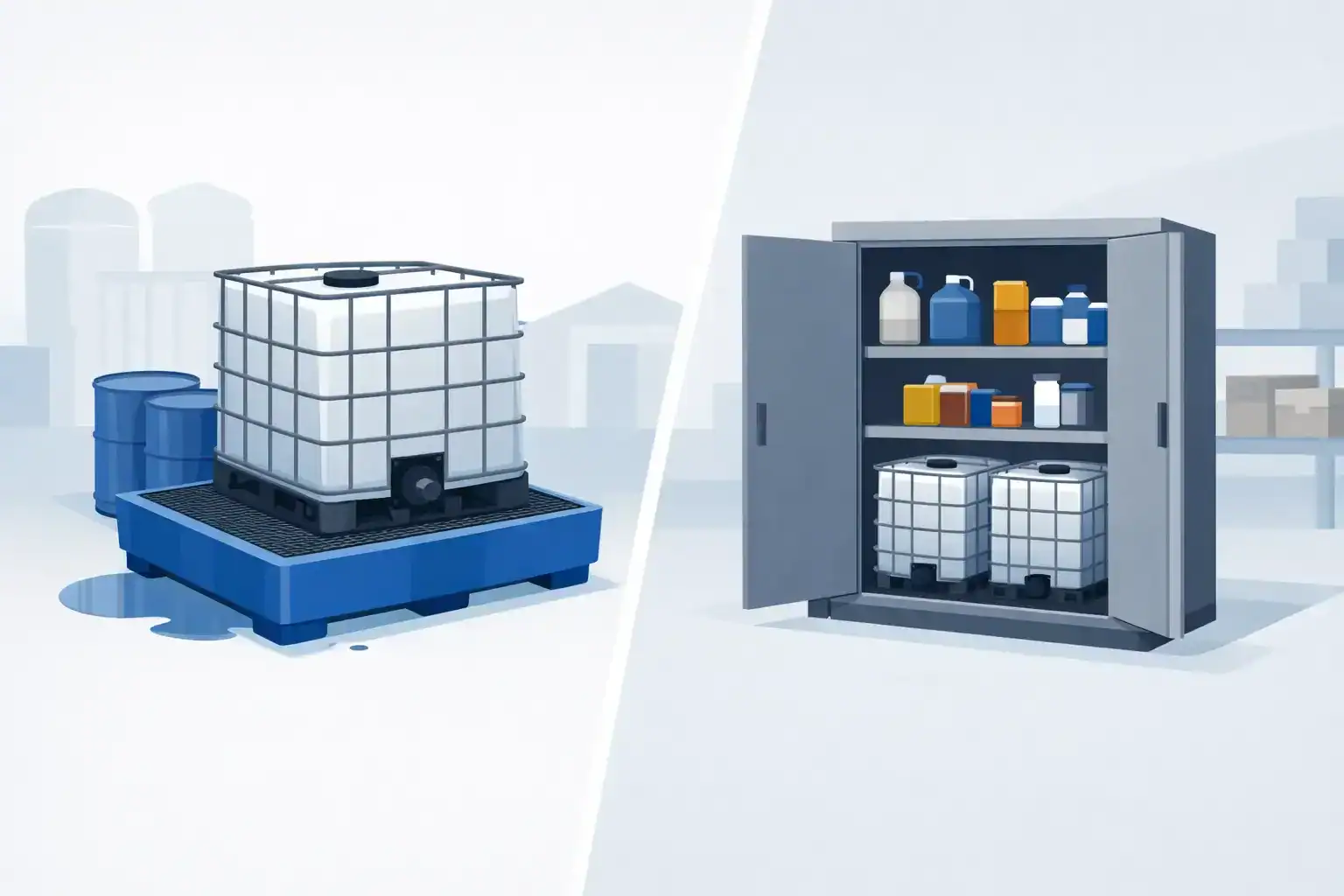
An IBC bund is primarily secondary containment. It captures leaks, drips and overfills from an intermediate bulk container so liquid does not reach the floor, drains or surrounding soil. A dangerous goods cabinet is primarily a controlled storage enclosure. It separates hazardous products from the workplace, helps manage ignition and access risks, and can provide integrated containment depending on the model.
Choosing the wrong one can leave a gap in your spill-control plan. Choosing both may be the right answer where bulk chemicals need containment and smaller quantities need secure, segregated storage.
IBC Bund Versus Cabinet: The Practical Difference
An IBC bund is a low-profile pallet or platform with a built-in sump. The IBC sits on top, while any escaped liquid is retained below. Many designs include a removable grate for easy placement and allow forklifts to position a full container. They are commonly used in workshops, warehouses, factories, agricultural operations and fuel-handling areas where liquids are stored or dispensed in bulk.
A cabinet encloses the stored product behind doors. For flammable liquids, purpose-built safety cabinets are designed for packaged goods such as tins, drums and jerry cans rather than a full IBC. They provide a dedicated location for hazardous liquids, help reduce exposure to everyday work activities and support sensible segregation. Outdoor dangerous goods cabinets may also be available in formats sized for larger containers, including IBCs, with a sump, weather protection and security features.
The key point is simple: a standard flammable liquids cabinet is not an alternative to an IBC bund when the container will not physically fit inside it. Equally, an open bund does not provide the enclosure, protection or access control of a cabinet.
Start With the Product You Are Storing
The storage method should reflect the safety data sheet, the chemical’s dangerous goods classification, the quantity held and the applicable site requirements. Flammable liquids, corrosives, oils, coolants, solvents and non-hazardous liquids do not all demand the same level of segregation or protection.
For a 1,000-litre IBC of diesel, oil or coolant used near a workshop, an IBC bund is often the practical starting point. It offers immediate secondary containment and keeps a potential leak away from the floor and stormwater system. If the IBC is used for decanting, select a bund that accommodates the dispensing arrangement and gives operators enough room to work without stepping into a potential spill area.
For smaller containers of flammable solvent, paint, thinners or cleaning chemicals, a compliant flammable liquids cabinet is usually more appropriate. The cabinet protects stock from day-to-day knocks, keeps incompatible products out of general storage areas and gives staff a clearly identified point of access.
Corrosives require an equally deliberate approach. A bund may contain a leak from an IBC, but the bund material must be compatible with the chemical. A cabinet selected for corrosives should also suit the substances stored inside it. Never assume one containment material or cabinet type suits every liquid.
When an IBC Bund Is the Better Fit
An IBC bund is generally the right choice when the principal risk is liquid escape from a bulk container. It is well suited to static storage, transfer operations and dispensing where a leak, split fitting or overfill could create a high-volume spill.
The practical benefits are clear. Bunds make use of vertical storage space because the IBC remains accessible from above and from the outlet valve. They are usually easier to integrate into an existing work area than a large enclosed store, and they provide visible confirmation that bulk liquid has secondary containment.
However, an open bund has limitations. It does not prevent unauthorised access, protect the IBC from impact in busy traffic areas or shield the container from weather when used outdoors. Rainwater can also enter an uncovered outdoor bund, reducing available sump capacity and creating contaminated liquid that must be managed correctly. A cover, canopy or purpose-designed outdoor unit may be necessary.
Bund capacity matters as much as the footprint. Check the sump capacity against the amount stored and the containment standard or site rule that applies to your operation. Do not choose a unit based only on whether it holds an IBC on top.
When a Cabinet Is the Better Fit
A cabinet is the better choice when safe storage depends on enclosure, controlled access, segregation or protection from external ignition sources. In a workshop, for example, leaving several 20-litre solvent drums on open shelving may be convenient, but it exposes them to traffic, hot work, poor housekeeping and casual handling. A correctly selected cabinet creates a defined storage point and makes stock control simpler.
Cabinets are also useful where products must be kept away from direct sunlight, rain, dust or unauthorised personnel. Outdoor dangerous goods cabinets can provide a more complete solution for larger hazardous-liquid holdings, especially where the site needs lockable storage, weather protection and spill containment in one unit.
The trade-off is cost, access and capacity. Cabinets take up more space for the volume stored, and their internal shelves, ventilation arrangements and sump must suit the actual packaging. They also need enough clear space around them for doors to open, inspections to occur and staff to retrieve stock safely.
Do Not Treat Containment and Storage as the Same Thing
The most common mistake is treating a bund as a complete dangerous-goods store. It is not. A bund controls the consequence of a release. It does not automatically address fire exposure, incompatible goods, security, weather or safe separation from people and processes.
The reverse mistake is assuming a cabinet removes the need for spill planning. A cabinet may have a built-in sump, but operators still need suitable absorbents, PPE and a clear response process. A leak can happen during delivery, decanting or transport before the product reaches the cabinet.
For many sites, the strongest arrangement is layered: bulk stock held in an IBC bund or outdoor IBC cabinet, smaller day-use quantities stored in the appropriate safety cabinet, and spill-response equipment positioned where transfer and dispensing occur.
Check These Site Conditions Before Buying
Before selecting equipment, walk through the actual storage and handling process. Consider the IBC’s full weight, how it will be moved, whether forklifts operate nearby, where the outlet valve faces and whether dispensing occurs over the bund. Confirm that staff can inspect the container, read labels and access emergency equipment without climbing, reaching or working in a restricted space.
Also consider these four operational questions:
- Is the stored liquid flammable, corrosive, toxic, environmentally hazardous or incompatible with nearby stock?
- Will the unit sit indoors, outdoors, under cover or in an area exposed to vehicle traffic?
- Does the storage location have drains, stormwater pits, waterways or sensitive ground nearby?
- Is the equipment being used for long-term storage, regular dispensing, temporary staging or waste-liquid collection?
These answers influence more than the product type. They determine whether you need a single-IBC bund, a multi-IBC spill pallet, an enclosed outdoor cabinet, a hard cover, a dispensing tray, bollard protection or a separate chemical store.
Installation and Inspection Still Matter
Place bunds and cabinets on stable, level ground capable of carrying the total loaded weight. Keep them clear of drains where possible and do not position them where a forklift strike or reversing vehicle is likely. Where traffic cannot be avoided, install appropriate physical protection.
Inspect IBCs, valves, hoses, cabinet doors, bund grates and sumps routinely. Look for bulging containers, damaged pallet bases, weeping fittings, chemical attack, rainwater accumulation and residue beneath outlets. A bund full of rainwater or old waste liquid is not ready to contain a fresh spill.
Any collected liquid needs to be assessed and disposed of through the correct waste process. Do not tip recovered chemicals, contaminated water or unknown liquids into drains.
The right choice is the one that matches the real hazard and the way your team works. If bulk liquid needs a practical safety net, start with correctly sized secondary containment. If the risk calls for enclosure, segregation and controlled access, choose a suitable cabinet. Where both risks exist, build the storage area around both controls rather than asking one product to do two jobs poorly.