Fuel Handling Spill Barriers: What Works Where

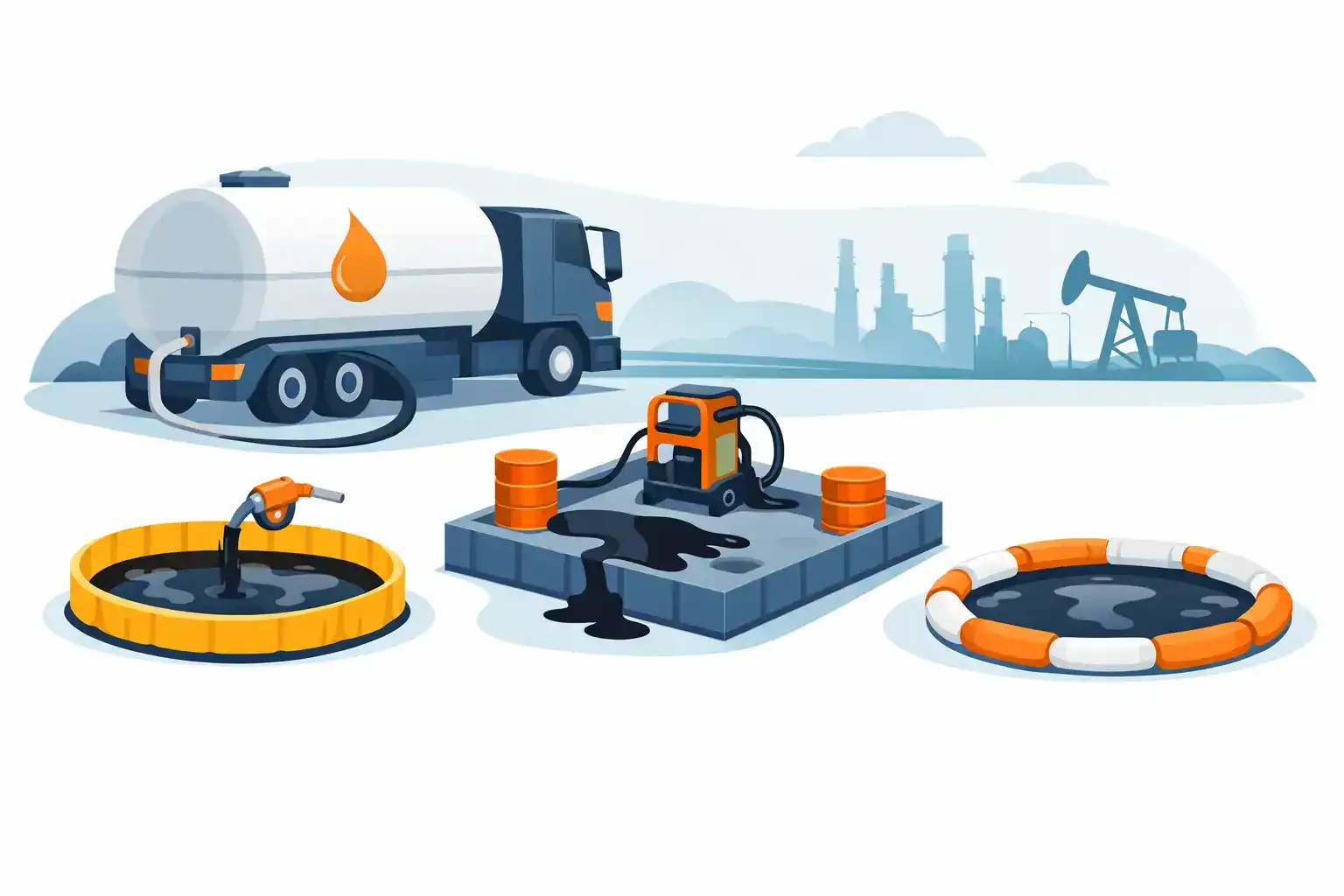
A fuel spill at a bowser, decanting point or mobile
refueling area rarely stays where it lands. It follows surface grades, tyre tracks and drains – often reaching the point where recovery becomes harder, more expensive and more disruptive. Fuel handling spill barriers provide the first line of physical containment, buying the site time to stop the source, protect drainage and recover liquid safely.
For operations managers, workshop supervisors and environmental officers, the right barrier is not simply a purchasing decision. It is part of a workable fuel-handling system: positioned where a release is most likely, compatible with the fuel in use and practical enough that workers will deploy it without delay.
Start with the spill path, not the product
The most useful question is not, “Which barrier is best?” It is, “Where will fuel go if this connection fails?” Map the likely release points around tanks, pumps, hose couplings, drums, IBCs, plant
refueling bays and vehicle loading areas. Then identify surface falls, stormwater pits, doorways, pavement joints and traffic routes.
Petrol, diesel and other hydrocarbons behave differently in some respects, but all can travel quickly across sealed concrete or bitumen. A small leak at a transfer hose may be contained with absorbent pads and a portable berm. A larger release from a tank connection may need a more substantial bunded area and drain protection. The credible spill volume should drive the containment approach.
This is where sites can make an expensive mistake: selecting a low-profile barrier for a location exposed to a high-volume release, or installing permanent bunding where vehicles must cross constantly and workers start bypassing it. Effective containment has to suit the real task, not just look compliant on a plan.
Common fuel handling spill barriers and their jobs
Portable spill berms for temporary containment
Portable berms create a contained floor area for drums, small tanks, fuel transfer equipment and maintenance tasks. They are particularly useful where fuel is handled in changing locations, such as field maintenance, plant shutdowns or temporary
refueling operations.
The main decision is wall design. Foam or flexible sidewalls suit hand-carried equipment and low-frequency access. Drive-over walls are designed for vehicles or plant that need to enter the berm, but they still require correct use and should be matched to the traffic load. A berm that is too small for the equipment footprint, or too low for the potential release volume, offers a false sense of security.
Check the base material for fuel compatibility, puncture resistance and suitability for the surface beneath it. Sharp aggregate, damaged concrete and protruding metal can compromise a portable unit before it is needed. Ground preparation matters as much as the barrier itself.
Fixed bunding around storage and transfer areas
Permanent bunding is generally the better option where fuel storage or transfer is routine and the risk location does not move. It can direct spills away from stormwater, contain leaks beneath equipment and provide a defined area for inspection and housekeeping.
The design needs to account for the largest credible release, rainfall where the bund is outdoors, and any equipment that displaces volume within the contained area. It also needs a managed approach to accumulated rainwater. Draining a bund without inspection can send contaminated water into the environment, while leaving water in place reduces the available containment capacity.
Fixed bunding should be considered alongside applicable dangerous goods, environmental and workplace requirements, including the storage arrangement, site conditions and fuel quantities involved. Compliance is not achieved by a wall alone. It relies on capacity, integrity, inspection, spill response and safe operating procedures working together.
Drain covers, barriers and diversion tools
Stormwater protection is often the most urgent part of a fuel spill response. Once fuel enters a drain, the incident can extend beyond the immediate work area and trigger a far more complex clean-up.
Drain covers provide fast, temporary sealing over pits and grates. They are valuable at loading zones, workshops,
refueling bays and any point where a spill could flow directly to drainage. For wider flow paths, absorbent booms and containment barriers can be placed across the surface to slow and redirect liquid towards a controlled recovery area.
These products work best when they are close to the risk point and clearly identified. A drain cover stored in a distant store room is not a fast-response control. Keep drain protection in spill kits, response cabinets or designated stations close to fuel handling areas, without creating an obstruction.
Flexible bunding for doorways and surface flows
Flexible bunding and low-profile containment barriers can be used to block doorways, isolate a work zone or redirect a spill away from drains and pedestrian areas. They are useful when a release is moving across a hardstand and crews need to establish control quickly.
Their limitation is volume and pressure. A low barrier can manage a shallow flow, but it is not designed to hold back a sustained, high-volume release. Use it as part of an immediate response, supported by source control, absorbents and recovery equipment.
Match barrier capacity to the credible spill
Capacity calculations should be practical, not optimistic. Consider the largest container, hose section or tank connection that could release fuel, plus the duration before someone can isolate the source. A slow leak that is detected immediately may require a very different response from a split transfer hose during an unattended shift.
Also allow for what reduces usable capacity. Equipment inside a berm takes up space. Uneven surfaces can allow liquid to pool outside the intended area. Rainwater, debris and poor housekeeping reduce freeboard in permanent bunds. If a barrier only works under ideal conditions, it is unlikely to perform reliably during an actual incident.
For high-risk locations, use layered controls. A bunded transfer area can be supported by nearby drain covers, hydrocarbon absorbents, booms and a suitable spill kit. The physical barrier contains the spread; absorbents recover liquid; trained workers isolate the source and manage the incident.
Fuel compatibility and ignition control matter
Fuel handling spill barriers must be suitable for the product they may contact. Materials should resist hydrocarbons and remain functional under expected temperature, weather and UV exposure conditions. This is especially relevant for equipment kept permanently outdoors or carried in vehicles.
Containment also does not remove flammability. Petrol vapours can ignite well beyond the visible liquid, and diesel spills can still create slip, fire and environmental hazards. Keep ignition sources controlled, follow site procedures for shutting down transfer equipment, and ensure the response equipment does not encourage workers to take unnecessary risks.
Where a spill involves fire, vapour, an unknown substance or a release beyond the capacity of site controls, escalation is the correct response. Barriers are designed to contain and manage a spill, not to replace emergency planning or specialist assistance.
Make deployment realistic for the people on site
The best equipment is equipment a worker can identify, reach and use under pressure. Site teams should know where barriers are stored, which drains need protection first, and how to deploy a portable berm or boom without spreading contamination themselves.
Short, task-specific training is more useful than a generic toolbox talk. Run through realistic scenarios: a nozzle left open, a drum punctured by a forklift, a hose coupling failure or fuel flowing towards a stormwater grate. Confirm who isolates the source, who protects drains, who deploys containment and who reports the incident.
Inspection should be routine. Check portable barriers for tears, hardened folds, damaged seams and contaminated surfaces. Inspect fixed bunds for cracks, failed seals, blocked sumps and unauthorised penetrations. Replace used absorbents and return response equipment to service immediately after an incident or drill.
Selecting fuel handling spill barriers for your site
A practical selection process starts with the fuel type, handling method, likely release volume, surface condition and drainage layout. Then consider traffic. A warehouse
refueling point with forklifts has different access requirements from a remote generator compound or marine fuel transfer area.
Avoid treating a spill barrier as a standalone compliance item. It should fit with your spill kits, absorbents, drainage controls, dangerous goods storage and operating procedures. When all components are selected for the same risk, response is faster and containment is more dependable.
Spillmaster supplies containment and spill-response equipment for workplaces that need clear, fit-for-purpose controls. The right barrier is the one that can be deployed at the point of risk, holds the likely release and helps keep fuel out of drains, work areas and the wider environment.