How to Use Spill Socks for Fast Spill Control

A leaking drum, split hose or overflowing container can put liquid on the move in seconds. Knowing how to use spill socks properly gives your team a fast first line of containment, helping keep a spill away from drains, doorways, machinery and traffic areas while the source is controlled.
Spill socks are flexible, absorbent tubes designed to form a barrier around or in front of a spill. They are not a substitute for stopping the leak or using the correct spill kit, but they are one of the most useful tools for controlling where liquid goes next. The right product, positioned early, can reduce clean-up time and limit environmental exposure.
What spill socks are designed to do
A spill sock absorbs liquid while creating a physical boundary. Its flexible outer casing allows it to follow the contour of floors, machinery bases, drains and uneven surfaces where a rigid barrier would leave gaps.
In a typical response, socks are used to encircle a spill, contain liquid at the source, divert flow away from a drain, or reinforce the edge of a spill area before absorbent pads, particulate or pillows are applied. They are especially useful for slow leaks that may continue while equipment is isolated or a transfer is stopped.
The amount a sock absorbs depends on its size, fill material and the liquid involved. Do not assume a sock will hold an unlimited volume. If liquid is spreading, add more socks and use compatible absorbents inside the contained area.
Choose the right spill sock before deployment
The correct spill sock depends on the substance, location and likely direction of travel. General-purpose absorbent socks are suited to common workshop and warehouse liquids such as oils, coolants, water-based fluids and many non-aggressive chemicals. They are often the practical choice for mixed-use maintenance areas.
Oil-only socks are intended for hydrocarbons such as oils, fuels and diesel. These repel water and absorb oil, which makes them suitable for marine, outdoor and wet-area applications where rainwater or surface water may be present.
Chemical spill socks are used where acids, caustics or other hazardous liquids are handled. The sock must be compatible with the substance involved. Check the safety data sheet, site procedure and product specifications before relying on any absorbent in a chemical response. Some spills require specialist emergency response, evacuation or additional PPE rather than a routine clean-up.
Length and diameter also matter. A thicker sock generally provides greater absorption and a stronger barrier, while shorter socks are easier to position around tight equipment or drain points. For large floor areas, longer socks can reduce joins and potential gaps.
How to use spill socks safely and effectively
Start by assessing the spill from a safe distance. Identify the substance if possible, look for ignition hazards, determine whether vapours are present and prevent people or vehicles from moving through the area. Wear PPE appropriate to the liquid and task. Depending on the hazard, this may include chemical-resistant gloves, safety eyewear, protective clothing and suitable respiratory protection.
If it can be done safely, stop or reduce the source first. Close a valve, upright a container, isolate a pump or place a temporary bung in a leaking drum. Spill socks control the spread, but a continuing release can quickly exceed their capacity.
1. Protect drains and low points first
Liquid will follow floor gradients, expansion joints and vehicle tracks. Before placing socks around the main spill, protect nearby drains, pits, grates and doorways in the likely path of travel. Lay the sock directly across the flow path, ensuring both ends extend beyond the expected width of the liquid.
For a drain, place a compatible drain cover where available, then position spill socks around it as a secondary barrier. A sock alone may not create a liquid-tight seal over a drain, particularly on rough or uneven concrete. Treat drain protection as a priority, not an afterthought.
2. Build a contained area around the liquid
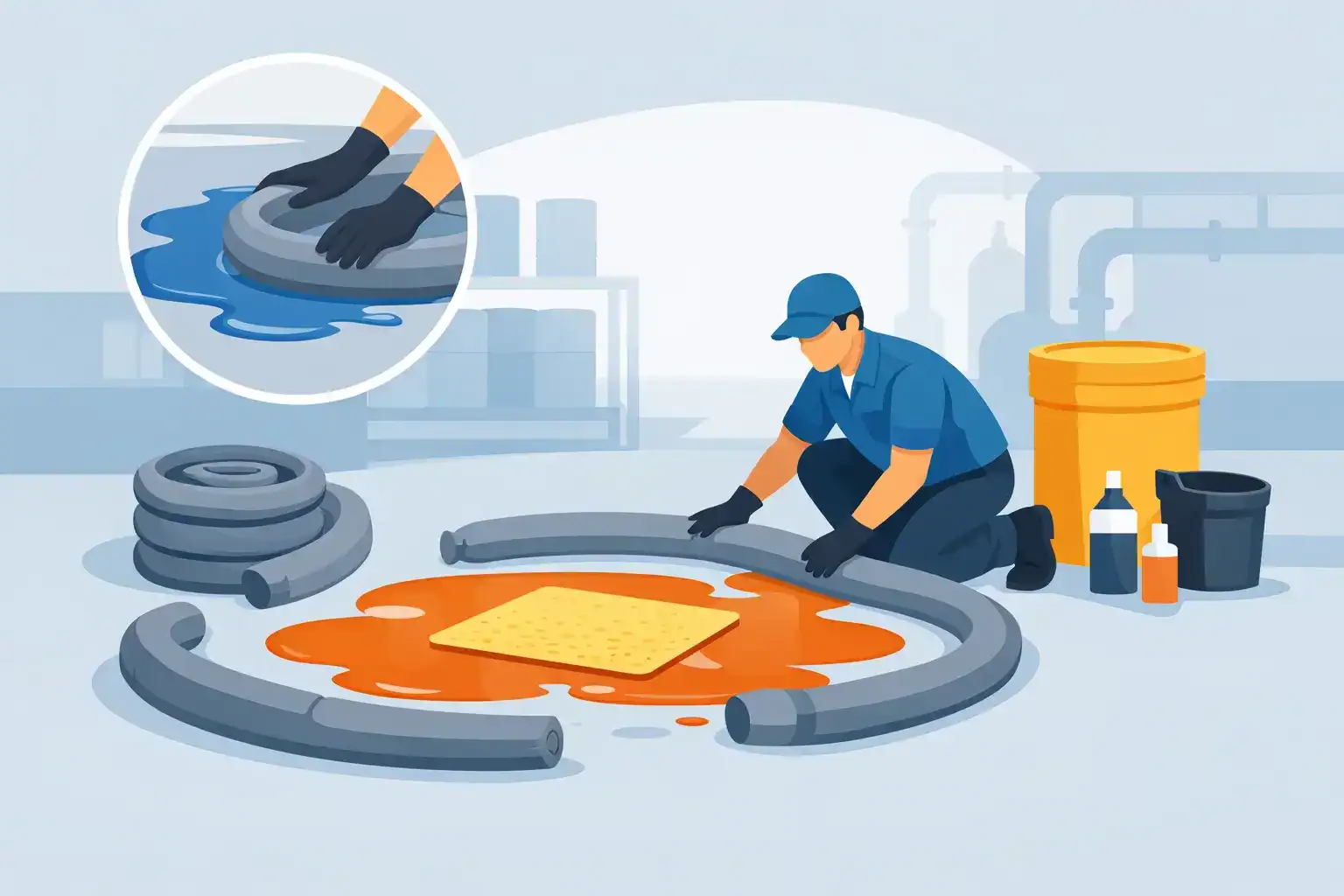
Place spill socks in a horseshoe or full circle around the spill, working from the downhill side first. Position each sock firmly against the next. Overlap the ends slightly rather than leaving them merely touching, as gaps can allow liquid to escape.
Keep the barrier close enough to contain the spill without putting workers into unnecessary contact with the liquid. For a spreading release, allow room inside the boundary for pads or other absorbents. If the spill reaches the sock line, add a second row outside the first rather than waiting for the barrier to become saturated.
3. Direct the liquid where you can manage it
Spill socks can be arranged as a curved or angled line to divert liquid towards a safe contained area. This is useful where a minor leak is moving towards a drain or access point. The barrier should guide the flow across a clean, level surface where additional absorbents can be deployed.
Do not attempt to channel a hazardous liquid over long distances or towards an unsuitable area. Diversion only works where the site layout, substance hazards and response plan support it. If a spill is large, volatile, unknown or likely to enter stormwater, escalate immediately under your emergency procedures.
4. Absorb the contained liquid
Once the spill has stopped spreading, place compatible absorbent pads, rolls, pillows or particulate inside the sock barrier. Work from the outside towards the centre where practical, avoiding steps that push liquid over the containment line.
Monitor the socks throughout the clean-up. Replace any that are saturated, damaged or no longer maintaining the barrier. On smooth floors, a sock may shift if it is kicked, dragged by equipment or exposed to a strong flow, so keep the area controlled until the response is complete.
Common placement mistakes that reduce containment
The most common error is placing one sock across the middle of a spill after it has already reached a drain. Containment is most effective when it is placed ahead of the flow and around the source early.
Another mistake is using the wrong absorbent type. Oil-only socks are valuable for fuel and oil on water or wet ground, but they are not the default choice for every workshop release. Likewise, a general-purpose sock should not be assumed suitable for aggressive chemicals. Match the absorbent to the liquid, then confirm your team has the necessary PPE and disposal arrangements.
Poor joins are another weak point. On cracked concrete, slopes or around pipework, press socks into the surface and overlap sections. Use extra socks at corners and low spots. A single straight line may look sufficient, but liquid often finds the smallest path around an end or through a gap.
When spill socks are not enough
Spill socks are designed for containment and absorption of manageable releases. They are not the right stand-alone response for every incident. Escalate the response if the substance is unidentified, highly flammable, gives off harmful vapours, reacts with water, threatens a drain or waterway, or exceeds the capacity of available spill equipment.
Large fuel spills, significant chemical releases and spills outside site boundaries may require emergency services, environmental notification or a specialist contractor, depending on the substance, location and applicable requirements. Follow the site emergency plan and safety data sheet. Do not expose workers to avoidable risk simply to save product or protect equipment.
Disposal and restocking after the response
Used spill socks must be treated according to the liquid they have absorbed. A sock contaminated with oil, fuel, solvent or chemical may be regulated waste and should not be placed in general rubbish. Place used absorbents in suitable labelled bags, drums or disposal containers, then arrange disposal in line with the safety data sheet, local requirements and your waste contractor’s instructions.
Record the incident, identify the cause and replace used items promptly. A spill kit with missing socks or depleted pads is not ready for the next leak. For sites that handle fuels, chemicals or frequent maintenance fluids, keep the relevant socks close to transfer points, loading areas, drains and plant rooms rather than storing all response equipment in one distant location.
A spill sock is a simple item, but its value depends on preparation and placement. When workers can identify the liquid, protect drains, contain the flow and use compatible absorbents without delay, small spills are far more likely to stay small.