Best Flammable Cabinets for Workshops in 2026

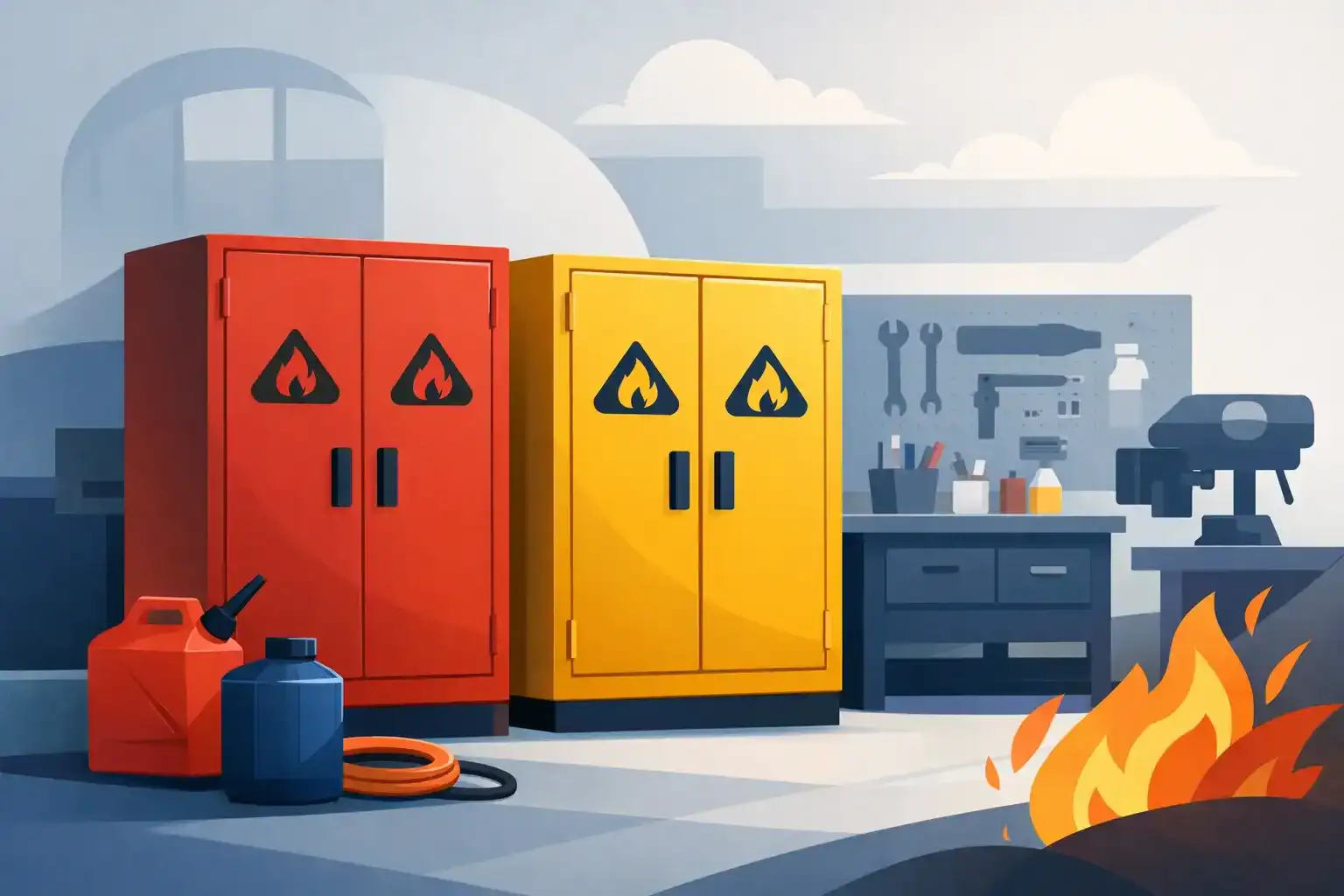
A flammable liquids cabinet is not simply a metal cupboard with a warning label. In a workshop, it is a controlled storage point for fuels, solvents, paints, thinners and other volatile products that can turn a small handling error into a serious incident. The best flammable cabinets for workshops are the ones that match the liquids on site, the quantities being held and the way your team actually works.
For a maintenance shed, fabrication shop, automotive workshop or marine facility, the right choice reduces ignition risk, contains minor leaks and helps keep dangerous goods storage orderly. The wrong choice can create its own problems: insufficient capacity encourages containers to be left on benches, while an oversized cabinet can consume valuable floor space and become a dumping ground for incompatible products.
What makes a flammable cabinet fit for workshop use?
A fit-for-purpose flammable liquids cabinet is built to protect its contents from external heat for a specified period and to contain leaks within the cabinet. It should be designed and labelled for flammable liquid storage, rather than repurposed from general workshop storage.
For Australian workplaces, storage arrangements should be assessed against the relevant dangerous goods requirements, including AS 1940, the storage and handling standard for flammable and combustible liquids. The applicable requirements can vary with the class of liquid, volume stored, workplace layout and local regulatory obligations. A cabinet that suits a small mechanics workshop may not be adequate for a high-volume fuel-handling area.
Start with the safety data sheets for the products you store. Confirm their dangerous goods classification, packing group and storage directions. This gives you a sound basis for deciding whether they belong in a flammable liquids cabinet and whether they need to be separated from other hazardous substances.
Choose cabinet capacity before choosing features
Capacity is usually the first practical decision. Buyers often focus on the cabinet’s external dimensions, but the usable internal capacity and shelf layout matter more. Allow enough room for the containers you hold now, plus sensible provision for routine stock levels. Do not select a cabinet on the assumption that every shelf can be packed tightly with mixed containers.
Small cabinets for point-of-use storage
Small cabinets work well where staff need limited quantities of solvents, aerosols or fuel additives at a workbench. They can reduce unnecessary trips to a central store and help keep day-to-day products under control. Their limitation is obvious: once they are full, excess containers often end up stored elsewhere without the same protection.
A small cabinet is best used as point-of-use storage, with bulk stock held separately in an appropriate dangerous goods store or larger cabinet. It should not become the only storage solution for an expanding workshop inventory.
Medium cabinets for active workshops
Medium-capacity units are commonly suited to automotive, maintenance and engineering workshops holding several common liquid products. They provide enough shelf space to separate container sizes and product types while maintaining a manageable footprint.
Look closely at shelf load ratings and the height between shelves. A cabinet may have an impressive litre capacity but still be inconvenient if five-litre drums, tins or jerry cans cannot be stored upright. Adjustable shelving is useful where stock changes regularly.
Large cabinets for centralised storage
Larger flammable cabinets suit workshops that receive liquid products in bulk or need one controlled location for multiple users. Centralising storage can improve stock control and reduce the number of hazardous liquid locations across a site.
The trade-off is placement. A large cabinet needs clear access, a level surface and enough space for doors to open safely. It must not obstruct exits, walkways, emergency equipment or vehicle routes. Before ordering, measure the location, including door swings, aisle clearance and access for delivery.
Features that matter when comparing flammable cabinets
Once capacity is right, compare the features that affect containment, durability and everyday use. Product specifications should be clear about construction, sump capacity, shelving and any tested fire-resistance performance. A cabinet should be selected on stated compliance and suitability, not appearance alone.
Key features to assess include:
- Double-wall steel construction and insulated air gaps, designed to slow the transfer of heat to stored liquids during a fire.
- A liquid-tight sump or spill containment base, sized to capture leakage from containers stored inside the cabinet.
- Adjustable, perforated shelves, which support containers while allowing small spills to drain safely to the sump below.
- Secure self-latching doors and compliant warning signage, helping prevent unauthorised access and clearly identifying the hazard.
- Vent ports with approved bungs, which allow the cabinet to remain sealed unless a properly designed ventilation arrangement is required.
Do not assume that all cabinet features are interchangeable. For example, ventilation is sometimes treated as an automatic requirement, but inappropriate venting can compromise a cabinet’s fire performance. If mechanical ventilation is being considered, seek competent advice and follow the cabinet manufacturer’s instructions and relevant site requirements.
Similarly, a drain outlet can be useful for controlled sump clean-out, but it must remain securely closed during normal operation. An open or poorly managed drain defeats the point of spill containment.
Placement is part of the storage solution
Even the best flammable cabinet will not perform as intended if it is placed in the wrong location. Position it away from ignition sources, direct heat, welding activity and areas where vehicles or forklifts could strike it. Keep the approach clear so operators can retrieve products without reaching across machinery, clutter or active work.
Avoid placing a cabinet in an exit path or where open doors could restrict evacuation. The cabinet should also be protected from impact. In busy workshops, bollards, barriers or a location outside vehicle travel paths may be necessary.
Consider the workflow as well as the compliance checklist. If technicians use degreaser or thinners at one end of a large workshop, a cabinet positioned on the far side may encourage informal storage at the bench. In some cases, a central cabinet for bulk stock and a smaller controlled point-of-use cabinet is the safer arrangement.
The cabinet should sit level and be fixed or secured where required by the manufacturer, site risk assessment or local conditions. Check that doors close fully and that no stored items project beyond shelves or interfere with the closing mechanism.
Separate incompatible products before they reach the cabinet
A flammable cabinet is for compatible flammable and combustible liquids. It is not a general chemical store. Oxidising agents, corrosives, toxic chemicals, gases and many other dangerous goods may need separate storage because a leak or fire involving incompatible materials can make the event significantly worse.
Read each product’s safety data sheet and maintain a current chemical register. This is particularly important in workshops that accumulate legacy products: unlabelled tins, old aerosols and partly used containers can quickly undermine an otherwise sound storage system.
Where practical, keep liquids in their original, labelled containers with lids secured. Transfer only into suitable containers that are clearly labelled for the contents. Never store fuel or solvent in drink bottles, food containers or damaged jerry cans. The cabinet contains spills, but it cannot compensate for poor container integrity.
A practical buying check before you order
Before selecting a cabinet, confirm the product classes and maximum volumes to be stored, the size and number of containers, the location available, and whether the cabinet will serve point-of-use or central storage. Our dangerous goods cabinet sizing guide can help with the capacity decision. Then check the cabinet’s stated construction, sump capacity, shelf configuration, door arrangement and compliance information.
Also plan for the surrounding controls. Suitable spill response materials should be available nearby, staff should know what is stored in the cabinet, and damaged containers should be dealt with promptly. A cabinet supports a broader dangerous goods management process; it does not replace training, housekeeping or emergency procedures.
For workshop buyers, price matters, but the lowest-priced cabinet is not automatically the best value. A cabinet that is too small, lacks adequate spill containment or does not suit the liquids being stored can create recurring operational and compliance costs. Choose a purpose-built unit that gives your team a clear, reliable place to put hazardous liquids every time they are not in use.
The most useful cabinet is the one your crew can use without shortcuts: correctly sized, clearly identified, properly located and backed by sensible spill and chemical-handling procedures. Once you have established the required capacity and location, compare the options in our flammable liquids storage cabinet range.