Hazardous Container Labelling for Australian Worksites

A 20-litre drum without a readable label is not just an inventory problem. It can lead to the wrong product being decanted, incompatible chemicals being stored together, or a spill being handled with the wrong PPE and absorbents. Effective hazardous container labelling gives workers the information they need at the point of use, before a routine task becomes an incident.
For Australian worksites, labels form part of a wider chemical management system that includes safety data sheets (SDSs), hazardous chemical registers, staff training, storage controls and emergency equipment. The label cannot replace those controls, but it is often the first and fastest warning a worker sees.
What hazardous container labelling must achieve
A label should allow a worker to identify the product, understand its key hazards and take basic precautions without having to guess. This applies to original supplier containers as well as containers used on site after a product has been transferred, mixed or diluted.
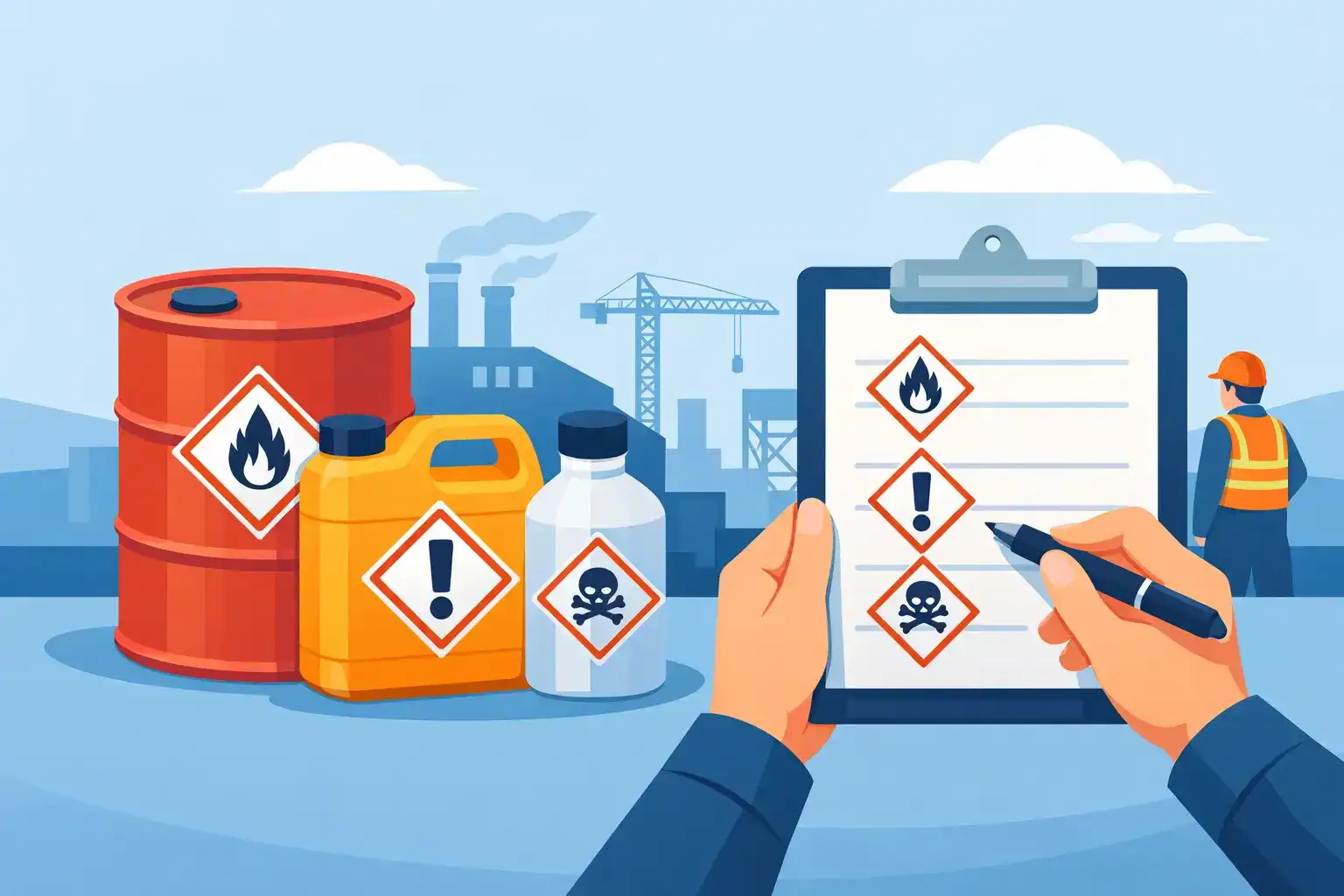
For hazardous chemicals supplied for workplace use, labels are generally aligned with the Globally Harmonised System of Classification and Labelling of Chemicals (GHS). A compliant supplier label commonly includes the product identifier, relevant hazard pictograms, a signal word such as Danger or Warning, hazard statements, precautionary statements, supplier details and any other information required for the chemical.
The practical test is straightforward: can a worker tell what the material is, what could harm them, and what controls are required? If the label is faded, damaged, partly covered by tape or written in a way that only one person understands, the answer is no.
Supplier labels and workplace labels are not the same
An unopened container arriving from a supplier should retain its original manufacturer or importer label. Do not remove, obscure or replace it with a handwritten description unless there is a proper reason and an equivalent compliant label is applied.
A workplace label is usually needed when a hazardous chemical is decanted from its original container into another vessel, such as a spray bottle, jerry can, smaller drum or process tank. The workplace label must identify the chemical and provide enough hazard information for safe use. The exact content can depend on the chemical, the workplace risk assessment and the applicable WHS requirements in your state or territory.
There is a limited practical exception for a container that is filled and used immediately by the person who decanted it. That exception should not become a workaround for unlabelled bottles left on benches, workshop shelves or inside service vehicles. If the container will be stored, handed to another worker or used later, label it.
The minimum information workers need
A clear workplace label is more useful than a crowded one, provided it contains the information needed to manage the risk. At a minimum, the product identifier should match the name used in the SDS and chemical register. This avoids confusion where several products have similar trade names or where the site uses a local shorthand.
The label should also communicate the relevant hazard. For a corrosive cleaner, that may mean a corrosive pictogram and clear direction to wear gloves and eye protection. For a flammable solvent, it should make the ignition risk obvious and reinforce the need to keep it away from sparks, hot work and incompatible storage areas.
Where the chemical has been diluted, identify both the product and the concentration or dilution ratio where that changes the risk or handling controls. A bottle marked only “degreaser” gives little assurance when the contents may be concentrated caustic cleaner, a ready-to-use solution or an entirely different product.
Make labels durable enough for the environment. Workshop chemicals may be exposed to oil, moisture, UV, abrasion and frequent handling. Labels on outdoor drums, marine equipment or fuel-handling containers need particular attention. Use a suitable printed or chemical-resistant label and replace it before it becomes illegible.
Match the label to the container and task
Hazardous container labelling is not limited to drums in a chemical store. It needs to follow the chemical through the way your site actually operates. That includes spray bottles used by cleaners, lubricants in maintenance bays, diesel additives, waste containers, bulk tanks, IBCs, laboratory containers and containers carried in a ute or site vehicle.
Containers should be fit for the material as well as correctly labelled. A label will not make an incompatible or damaged container safe. Check that the vessel is chemically compatible, has a secure closure and is suitable for the pressure, temperature and handling conditions involved. Never use food or drink containers for hazardous chemicals. Their familiar shape creates an avoidable risk of accidental ingestion.
Waste needs the same discipline. Waste drums and bins should state what they contain, the principal hazards and the date or waste stream details required by your site procedures. “Waste” is not a useful label when a contractor, emergency responder or waste provider needs to know whether the container holds oily water, solvent-contaminated absorbent, acid residues or mixed chemical waste.
Do not confuse workplace labels with transport marks
A chemical container prepared for road, rail, sea or air transport may need dangerous goods marks and documentation under the Australian Dangerous Goods Code. These requirements can include the UN number, proper shipping name, class label, packing group where applicable, environmental hazard marks and transport documentation.
Those transport requirements are related to, but not identical with, workplace hazardous chemical labelling. A drum may need both sets of information depending on how it is supplied, stored and moved. Similarly, an outer package may carry transport marks while inner containers require their own compliant labels.
This is one area where assumptions create expensive mistakes. If your operation consigns dangerous goods, check the classification, packaging, marking, placarding and documentation requirements for the specific product and transport mode. Do not rely on a warehouse label as evidence that a consignment is transport-ready.
Build labelling into receiving, storage and spill response
Good labelling is easier to maintain when it is built into normal site routines rather than treated as an occasional compliance check. At goods receival, inspect incoming containers for damaged or missing labels and quarantine any container that cannot be confidently identified. Confirm that the SDS is current and that the chemical is included in the site register before it is issued for use.
During storage inspections, look for labels that are lifting, faded or contaminated. Check that labels face outward on shelves and within bunded areas where possible. Workers should not have to move containers or lean over a spill pallet to find out what is stored there.
For spill response, labels support the first decisions: isolate the area, select appropriate PPE, prevent entry to drains and choose absorbents compatible with the liquid. Oil and fuel spills can often be managed with general-purpose or hydrocarbon absorbents, while corrosive or unknown chemicals need a more cautious approach. If the contents are unknown, treat the situation as higher risk, prevent unnecessary exposure and escalate under the site emergency procedure.
Common failures worth correcting
The same failures appear across workshops, warehouses and industrial sites. They are usually simple, but the consequences are not.
- Decanted bottles labelled only with a nickname such as “blue cleaner” or “solvent”.
- Original labels covered by tape, secondary stickers or residue from old labels.
- Unlabelled waste drums left near bunding or loading areas.
- Labels that do not match the SDS or the product listed in the chemical register.
- Faded labels on outdoor containers, bulk tanks and fuel-handling equipment.
- Containers transferred between departments without confirming their identity and hazard controls.
Correcting these issues does not require complicated systems. It requires clear responsibility, suitable labels on hand, trained workers and routine inspections that treat missing identification as a defect.
Keep compliance practical
Australia’s model WHS framework is implemented differently across jurisdictions, and some industries or sites may have additional requirements. Check the legislation and codes applying to your state or territory, along with any customer, port, mining or contractor standards that govern the work.
A sensible site procedure should state who can decant chemicals, when a workplace label is required, where label templates are kept, how unidentified containers are quarantined and who checks labels during inspections. Train workers using the actual containers and products they handle, not generic examples alone.
The best label is the one that remains readable, matches the SDS and prompts the right action when a worker is under pressure. Keep replacement labels and suitable containers available where chemicals are used, so the safe option is also the easy option.