Sump Pallet Versus Bunded Floor: Which Fits?

A leaking 205 L drum can turn a clear warehouse aisle into a shutdown, a clean-up task and a reportable environmental risk within minutes. The sump pallet versus bunded floor decision determines whether that leak is contained at the storage point or allowed to spread across a larger area. For many sites, the right answer comes down to what is being stored, how it is handled and whether the storage layout is likely to change.
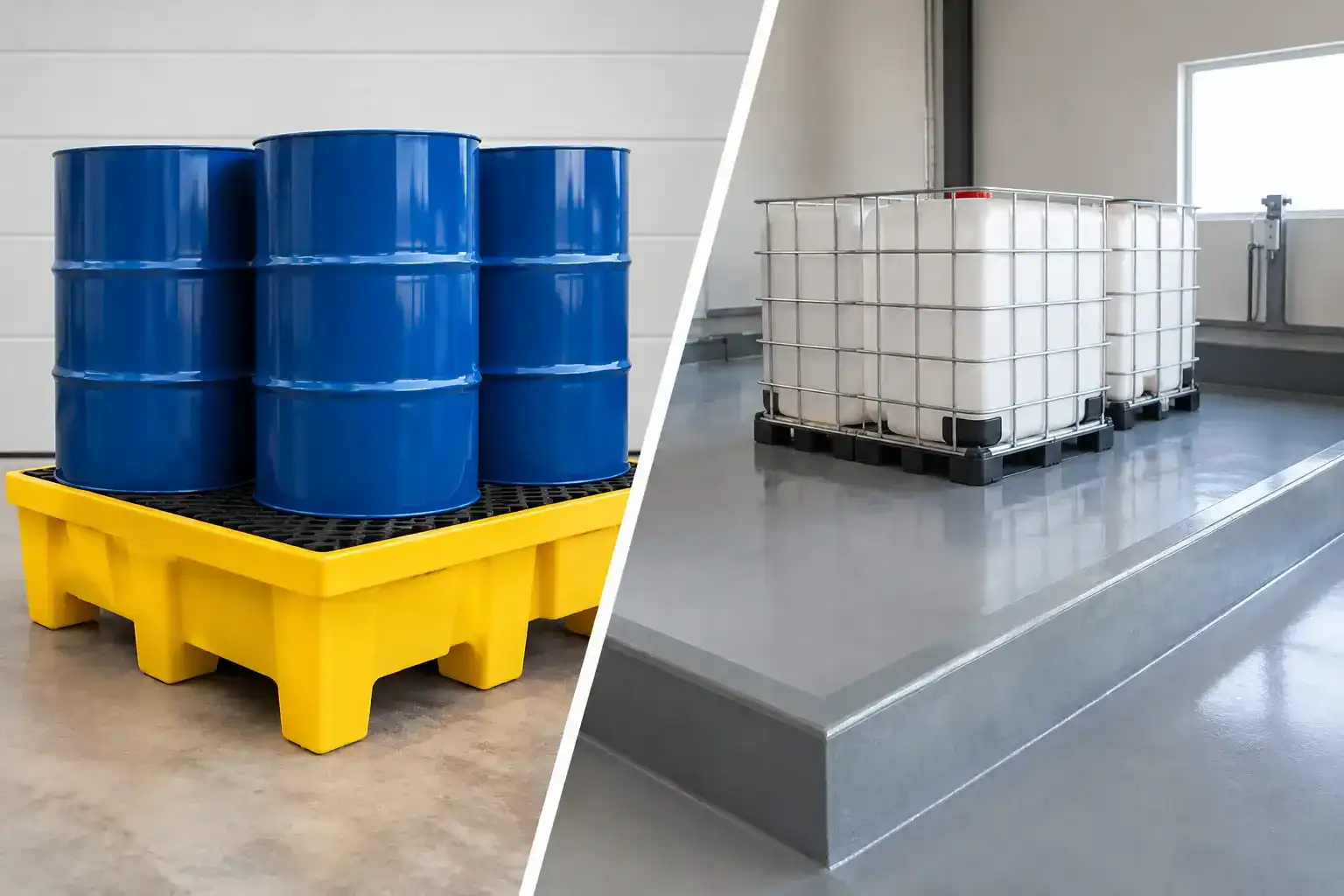
Both options provide secondary containment. Both can support safer storage of oils, fuels, chemicals and other hazardous liquids. They are not interchangeable, however. A sump pallet is generally a contained, movable platform for drums or IBCs. A bunded floor is a fixed or modular containment area designed to manage a larger storage footprint, frequent handling or multiple container types.
Sump pallet versus bunded floor: the practical difference
A sump pallet places secondary containment directly beneath containers. It has an integrated sump that captures leakage, drips and small spills from the drums, jerry cans or IBCs stored on it. Most are made from chemical-resistant polyethylene, although steel options are available for applications where compatibility and load requirements call for them.
A bunded floor creates a defined containment zone across a section of floor. It may be a purpose-built concrete bund, a modular bunding system with ramps and flooring, or a contained work area. The perimeter prevents liquid from travelling beyond the zone, while the floor contains spills from stored containers, decanting work or equipment use.
The simplest distinction is scale and operating method. A sump pallet is suited to individual storage units and relatively contained handling. A bunded floor is suited to an area where people, trolleys, drum lifters or forklifts need to move around the stored goods.
Neither is automatically the more compliant choice. The equipment must be appropriate for the hazard, liquid compatibility, storage volume, site conditions and relevant legal, environmental and Australian Standard requirements.
When a sump pallet is the better fit
Sump pallets work well where storage is compact, the stock profile changes regularly or containment needs to be deployed without building works. A workshop storing several oil drums, a maintenance shed with coolant and lubricant containers, or a small chemical store with limited floor space can often manage risk effectively with correctly sized pallets.
They are especially practical for palletised drums and IBCs. The containment sits under the load, making it clear which products belong in the designated storage position. This supports better housekeeping and helps prevent containers being left directly on bare concrete.
For operations that move materials between bays, depots or project locations, portable containment also has a clear advantage. A pallet can be relocated as storage needs change, provided it is emptied, inspected and moved safely. That flexibility can reduce the cost and disruption of altering a fixed storage area.
Capacity and load rating matter
Do not select a sump pallet only by the number of drums it holds. Check both the sump capacity and the static load rating. A four-drum pallet may physically fit four 205 L drums, but the containment volume still needs to meet the applicable requirement for the liquids and total storage arrangement.
A commonly applied benchmark is containment for at least 110% of the largest container or 25% of the total volume stored, whichever is greater. Requirements can vary by substance, jurisdiction, storage quantity and site approvals, so verify the applicable rules before purchase.
Also check whether the pallet will be loaded by forklift, drum trolley or manually. Fork pockets, grate strength, chemical resistance and safe access to the containers all affect whether the product will work in daily use.
Where sump pallets have limits
A sump pallet is not ideal when regular decanting occurs on top of it, when operators need room to manoeuvre, or when containers are frequently transferred across the storage zone. Repeated handling can create a higher chance of impact damage, splashing or containers being temporarily placed outside the containment area.
They can also become difficult to manage if a site adds more drums over time. Multiple small pallets may appear economical at first, but can leave narrow access ways, separate spill zones and inconsistent labelling. At that point, a larger contained area may be easier to supervise and maintain.
When a bunded floor is the better fit
A bunded floor is usually the stronger choice for dedicated chemical stores, fuel-handling areas, battery charging zones, wash-down areas and larger drum storage rooms. It gives the site a defined containment boundary rather than relying on each pallet to manage its own spill risk.
This format is well suited to operations with regular material movement. Workers can use pallet jacks, drum lifters and, where the system is designed for it, forklifts within the contained area. Ramps make access easier, and a continuous bunded surface reduces the risk of a drum being set down just outside a pallet sump.
A bunded floor also supports a more organised storage layout. Incompatible substances can be separated into designated sections, spill kits can be positioned at exits, and teams can maintain clear access for inspections. For larger facilities, that visibility is often as valuable as the containment capacity itself.
Design for the real spill scenario
The bund wall height, floor area and total containment volume need to be calculated for the actual inventory, not the intended minimum stock level. Allow for peak deliveries, partly used containers, IBC storage and any liquid that could be released during transfer activities.
Drainage needs careful control. A bund should not have an open drain to stormwater or sewer. If a drainage point is required for approved management of rainwater or cleaning water, it should be controlled, secured and managed under site procedures. Any liquid within the bund may be contaminated and should be assessed before disposal.
Chemical compatibility is equally important. Some liquids can attack seals, coatings or flooring materials. Flammable liquids may require additional controls relating to ignition sources, ventilation, separation distances, fire protection and cabinet or store design. Secondary containment is one control within a broader hazardous materials system.
The trade-off: cost and permanence
A bunded floor generally requires more planning and a higher initial outlay than a sump pallet. Fixed concrete bunds may involve design, approvals and site works. Modular systems can be quicker to install, but they still need suitable floor conditions, correct assembly and consideration of traffic loads.
Once installed, the storage layout is less flexible. That is not necessarily a disadvantage. For a stable, high-volume chemical store, permanence can improve discipline and simplify inspections. But a business with seasonal stock, mobile operations or an evolving warehouse layout may prefer containment that can move with the operation.
Questions to ask before choosing containment
Start with the liquids, not the product catalogue. Identify what is stored, its hazard classification, container size, maximum quantity on site and whether incompatible materials must be segregated. Then consider how those products arrive, where they are used and who handles them.
A sump pallet may be appropriate if containers remain in one position, storage volumes are moderate and the space needs flexibility. A bunded floor is more suitable where the area functions as an active handling and storage zone, where stock is extensive, or where one contained boundary will improve access and control.
Consider these operational factors together:
- maximum liquid volume and required containment capacity
- container type, including drums, IBCs, tins and jerry cans
- chemical compatibility with the pallet, flooring, grates and seals
- access requirements for people, trolleys, forklifts and drum-handling equipment
- segregation of fuels, acids, alkalis, oxidisers and other incompatible goods
- inspection, cleaning and spill recovery arrangements
The best containment system is one staff can use correctly every day. If access is awkward, drums are hard to inspect or the area encourages shortcuts, even a well-specified product can underperform.
Set up the area for spill response, not just storage
Secondary containment limits the spread of a release, but it does not remove the need for spill response equipment. Keep suitable absorbents, drain protection, PPE and waste bags close enough to be used immediately without blocking emergency access. The spill kit should match the likely liquid – general purpose absorbents are not a substitute for chemical-specific products where corrosives or unknown liquids may be involved.
Inspect pallets and bunded areas routinely for cracks, distorted grates, damaged ramps, overflowing sumps and accumulated rainwater or residues. Empty collected liquid promptly and dispose of it through an approved process. A sump full of contaminated liquid has little remaining capacity when the next leak occurs.
For sites purchasing containment as part of a broader spill-control program, Spillmaster can help match practical bunding and spill response equipment to the storage task. The key is to specify the containers, liquids, quantities and handling method before selecting a solution.
Choose the option that contains the credible spill, supports safe handling and remains workable when the warehouse is busy. That is the containment arrangement your team is most likely to maintain properly.