Bunded Pallet Requirements for Australian Worksites

A leaking 205-litre drum can turn a storage corner into an environmental incident quickly. Meeting bunded pallet requirements is not simply a matter of placing drums on a plastic tray. The pallet must contain a realistic loss of product, suit the chemicals being stored, remain accessible for handling and fit the wider storage controls on site.
For warehouse managers, workshop supervisors and EHS teams, the right bunded pallet reduces clean-up time and helps prevent liquids reaching drains, soil, forklifts and walkways. The wrong one can create a false sense of security – particularly when capacity, chemical compatibility or placement has not been checked.
What is a bunded pallet?
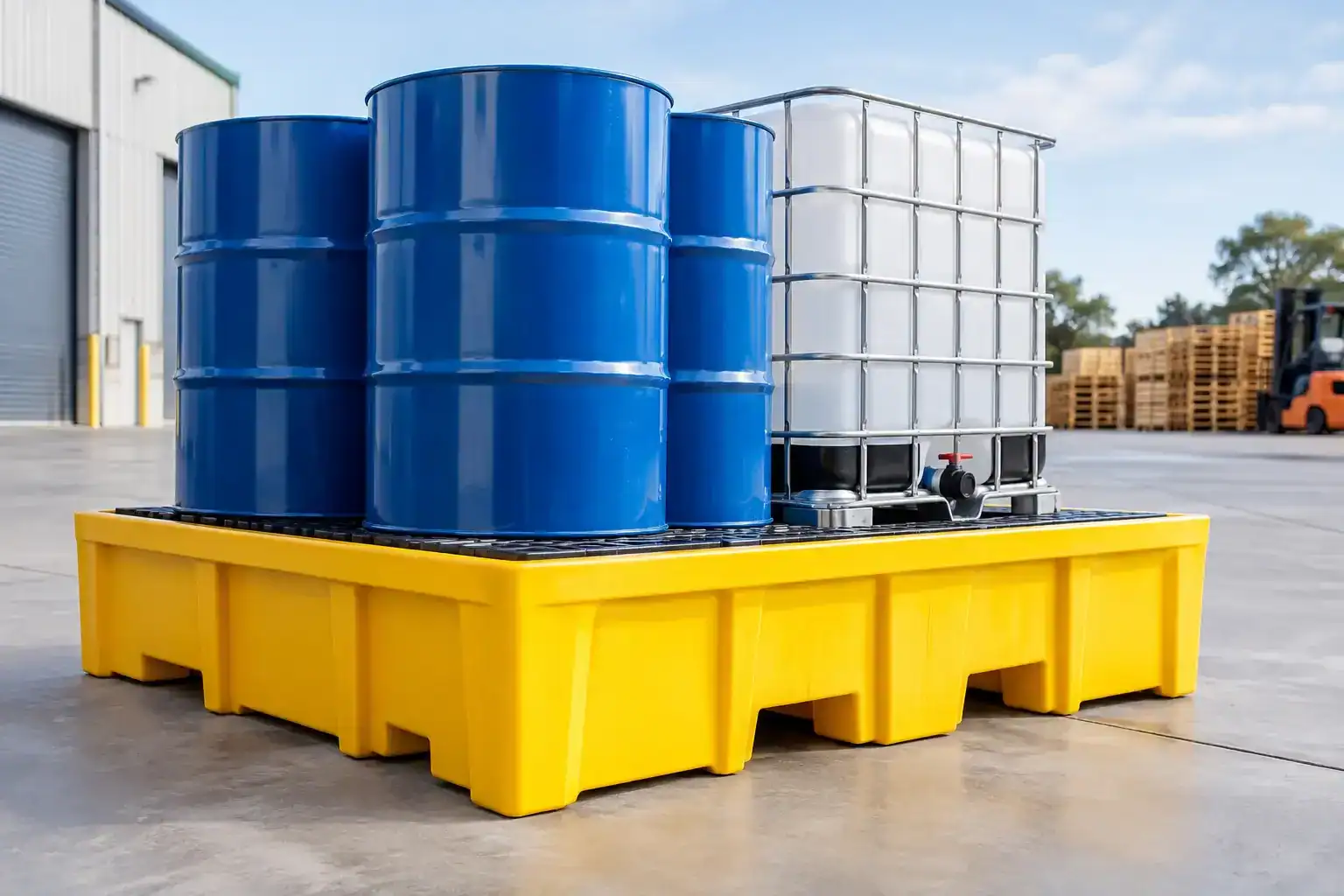
A bunded pallet, also called a spill pallet or containment pallet, is a raised platform with an integrated sump. Drums, jerry cans, pails or other containers sit above the sump on a removable grate. If a container leaks, the liquid is retained below the stored containers rather than spreading across the floor.
Bunded pallets are used for oils, fuels, coolants, chemicals and other potentially hazardous liquids. They are commonly supplied in one-drum, two-drum and four-drum configurations, as well as low-profile models for easier loading and larger modular systems for drum stores.
A bunded pallet is secondary containment. It does not make damaged containers safe to use, and it does not replace safe decanting procedures, spill kits, labelling, segregation or dangerous goods storage controls.
Bunded pallet requirements start with containment capacity
Capacity is the first specification to check. In many Australian workplaces, a commonly applied benchmark is that secondary containment should hold at least 110% of the volume of the largest container stored. Some site rules, environmental approvals, insurers or local requirements may require a different calculation, including a percentage of the total volume stored.
The applicable requirement depends on the substance, quantity, location and jurisdiction. Check the relevant WHS duties, environmental requirements, dangerous goods rules, safety data sheets and site procedures before selecting equipment. Where the storage arrangement is covered by a specific code, licence condition or engineering design, that direction takes priority over a general rule of thumb.
Do not assess a pallet by its external dimensions alone. Look for the stated sump capacity, then compare it against the actual container volume. A four-drum pallet holding four 205-litre drums, for example, needs enough usable sump volume to manage the required containment calculation after allowing for the volume displaced by the grate and containers.
Overfilling the pallet creates another problem. If a pallet is designed for four drums, adding extra pails or a fifth drum may reduce available containment below the required level. Storage capacity and sump capacity must both be suitable.
Allow for rain and wash-down exposure
Outdoor storage needs closer attention. An uncovered pallet can collect rainwater, reducing free sump capacity before a leak occurs. Contaminated water may also become regulated waste and must not be emptied to stormwater.
Use weather protection where practical, inspect outdoor units after rain and maintain a controlled method for removing accumulated liquid. A bunded pallet under a roof, canopy or purpose-built chemical store is generally easier to manage than one left exposed in an open yard.
Select materials that suit the liquid
Most bunded pallets are manufactured from polyethylene because it is durable, corrosion-resistant and suitable for many common oils, fuels, coolants and chemicals. That does not mean every polyethylene pallet is suitable for every substance.
Check chemical compatibility against the product being stored, including its concentration and temperature. Strong oxidisers, aggressive solvents and particular corrosives may need a different containment material or a verified chemical-resistant design. The safety data sheet is a starting point, but the pallet manufacturer’s compatibility guidance should also be reviewed.
For flammable liquids, bunding is only one part of the control measure. Consider ignition sources, ventilation, quantities, separation distances, fire protection and whether a compliant flammable liquids cabinet or dedicated dangerous goods store is required. A spill pallet should not be treated as a substitute for compliant flammable liquids storage.
The same principle applies to incompatible chemicals. Acids, alkalis, oxidisers, fuels and solvents may require segregation even if each container is individually closed. If incompatible liquids can mix in the same sump during a leak, one containment pallet may not be appropriate.
Check the load rating and handling method
A bunded pallet must safely support the full operational load, not just the nominal drum count. Calculate the combined weight of containers at their maximum fill level, including pallets, dispensing equipment or any other items placed on top.
This is particularly relevant for steel drums of dense chemicals. Four 205-litre drums can weigh well over a tonne depending on the product. Confirm the pallet’s static load rating and, where relevant, its dynamic rating for movement while loaded.
Forklift pockets can make a pallet easier to position, but they do not automatically mean it is safe to lift when full. Follow the manufacturer’s handling instructions. Some units are designed to be moved only when empty, while others can be relocated loaded under specified conditions. Dragging pallets across concrete, lifting them from the wrong points or pushing tynes through the sump area can crack the unit and compromise containment.
Low-profile pallets reduce lifting height when loading drums with a drum trolley or from a ute. Higher-profile models may provide more sump capacity. The better option depends on whether manual handling, capacity or access is the greater operational constraint.
Place bunded pallets where they can work properly
Location determines whether containment remains effective during an incident. Position bunded pallets on a level, stable surface away from floor drains, stormwater pits, doorways, traffic lanes and areas where forklifts may strike stored drums. Keep sufficient clearance for inspections, drum handling and emergency response.
Avoid placing a pallet directly in front of an exit, electrical switchboard or fire equipment. If containers are routinely decanted, place suitable absorbents and a compatible spill kit nearby. Drips often occur during transfer rather than while a drum is sitting in storage.
The pallet should not be used as a general workbench. Tools, cartons and loose equipment make it harder to spot leaks and can obstruct access to the sump. Maintain clear labels on containers, ensure bungs are closed when not in use and fit taps or drum funnels correctly where dispensing occurs.
Where drum storage is part of a larger dangerous goods area, assess separation from other chemical classes, vehicle routes and ignition sources as part of the overall layout. A well-sized bunded pallet cannot correct a poorly planned storage area.
Inspection and maintenance are ongoing requirements
A bunded pallet is passive equipment, but it still needs routine checks. Include it in regular workplace inspections and inspect it immediately after a leak, vehicle strike or harsh weather event.
Check for cracks, distortion, UV degradation, damaged grates, blocked drain fittings and pooling liquid in the sump. A bowed or cracked pallet may no longer provide its rated capacity. Replace damaged units rather than attempting improvised repairs that could fail under load or chemical exposure.
If product has leaked into the sump, identify the source before returning containers to service. Recover the liquid using suitable absorbents or transfer equipment, then manage contaminated materials as required by the product and local waste controls. Never wash the sump out to a drain.
Keep a simple record of inspections, incidents and corrective actions. This supports site maintenance, helps demonstrate that containment equipment is being managed and can reveal recurring issues such as failed drum bungs or poor decanting practices.
A practical purchasing checklist
Before ordering a bunded pallet, confirm the largest container volume, total liquid volume, drum quantity, liquid type, compatibility needs, expected load and handling method. Then assess where the pallet will sit, whether it is exposed to weather and whether stored chemicals need segregation.
Also check whether the unit needs a drain, a removable grate, forklift pockets, a dispensing shelf or a low-profile design. These features are useful when they match the task, but they should not override containment capacity and chemical suitability.
For sites with mixed chemicals or changing stock, it is often safer to use separate, clearly identified containment areas rather than trying to make one pallet serve every liquid. Clear product selection upfront is usually less costly than managing a contaminated spill or replacing damaged stock later.
Bunded pallets are straightforward equipment, but their role is serious. Select them around the actual liquids, loads and work practices on your site, then keep them clean, intact and ready to contain the spill you hope never occurs.