IBC Bund vs Spill Deck: Which Containment Fits?

A leaking IBC can release hundreds of litres before anyone reaches a valve, finds a drum plug or deploys absorbent. That is why the IBC bund vs spill deck decision should be made before containers arrive on site, not after a leak has reached the warehouse floor, yard or stormwater system. Both products provide secondary containment, but they suit different storage arrangements, handling methods and operational risks.
The right choice comes down to more than footprint and price. You need to account for the number of IBCs or drums being stored, the liquid involved, the required containment capacity, forklift access, available space and how the area will be cleaned or managed after a spill.
IBC bund vs spill deck: the practical difference
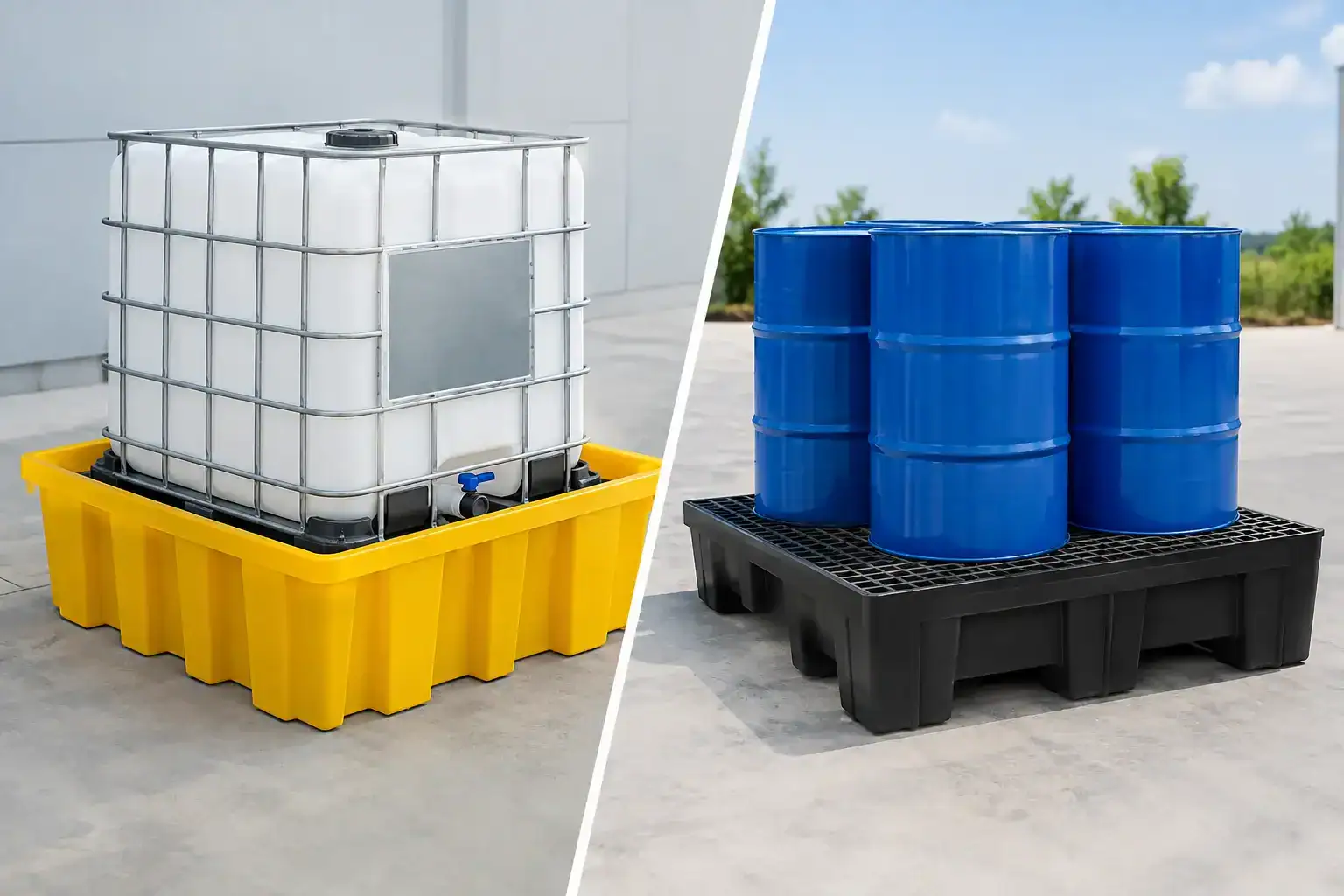
An IBC bund is a purpose-built containment unit designed around intermediate bulk containers. It generally has a larger sump, higher sidewalls and sufficient load rating for one or more full IBCs. Many units include an integrated grate or platform that keeps the container above the containment area. If a valve drips, a fitting fails or the IBC is damaged, the liquid collects in the sump rather than spreading across the site.
A spill deck is a low-profile containment platform, commonly used for drums, smaller containers and decanted liquids. It has a shallow sump and a broad, accessible deck. Spill decks may be used individually or connected to create a larger bunded storage area. Their low height is useful where staff regularly handle containers by hand, use drum trolleys or need easier access than a taller IBC bund provides.
Put simply, an IBC bund is usually the better fit for full-height bulk containers and higher containment volumes. A spill deck is generally better suited to low-level drum storage, dispensing points and adaptable containment layouts. There are exceptions, particularly with modular systems, so product dimensions and sump capacity must always be checked rather than assumed.
Start with the liquid and the containment requirement
Secondary containment is not just a housekeeping measure. It is part of controlling the environmental and workplace risk associated with stored liquids. Oils, fuels, coolants, solvents, acids, alkalis and other chemicals can create slip hazards, fire risks, chemical exposure and environmental harm if they escape into drains or soil.
Before selecting either product, identify what is being stored and review the current safety data sheet. The liquid’s chemical compatibility matters. A bund or deck made from polyethylene is widely used because it resists many oils, fuels and chemicals, but it is not automatically suitable for every substance. Strong oxidisers, aggressive chemicals and high-temperature liquids may require a specific containment material or storage arrangement.
Capacity is equally important. Your site may need to meet requirements set by its state or territory regulator, environmental authority, insurer, lease conditions or internal procedures. The required sump volume can depend on the largest container stored, the total volume in the area and whether the storage is indoors or outdoors. Do not treat a small spill deck as an IBC solution simply because an IBC can physically sit on top of it. A platform can carry the load yet still lack the required spill capacity.
Where flammable liquids are involved, containment is only one part of the control measure. Separation distances, ignition sources, ventilation, segregation and suitable flammable-liquid storage may also need to be considered. A bund does not replace a compliant storage cabinet or a site-specific dangerous goods assessment.
When an IBC bund is the better choice
Choose an IBC bund when bulk storage is permanent or semi-permanent, particularly where a full IBC is stored in a warehouse, workshop, plant room, farm shed, fuel-handling area or chemical store. The deeper sump and higher sides provide a more realistic response to a substantial release from an IBC valve or container wall.
A single IBC bund works well where containers are stored and dispensed one at a time. Multi-IBC bunds are more efficient where stock rotation requires several containers to be held together. The main benefit is controlled containment in one defined area, which helps operators inspect valves, keep incompatible products apart and maintain clear access for spill response.
Consider handling equipment before purchasing. A full IBC is heavy and must be placed safely on the bund using suitable plant. Check the bund’s load rating, dimensions, fork-entry points where applicable, grate design and whether the forklift can place and remove an IBC without striking sidewalls. In tight facilities, also allow room for turning, pallet movement and inspection access.
An IBC bund can take up more space than a low-profile system and may require a higher lift height to load. Those are reasonable trade-offs where the stored volume and consequence of a release are high.
When a spill deck makes more sense
Spill decks suit operations that need low-level, flexible containment. A workshop might use one beneath several 20-litre containers and drums. A maintenance team may create a contained transfer zone for oils and lubricants. In a warehouse, connected decks can form a practical storage area where drum sizes, stock volumes and layouts change regularly.
The lower deck height reduces manual-handling effort when personnel need to use pumps, taps or funnels. It can also make drum trolleys and pallet jacks easier to use, provided the selected deck is designed for that traffic and the manufacturer’s load limits are followed. Never assume a standard spill deck is suitable for forklifts, pallet jacks or loaded pallets without confirming the specification.
A spill deck is often the more economical choice for smaller-volume storage, but it has limits. Its shallow sump may fill quickly during a major release, especially if several containers are stored above it. It can also be unsuitable for outdoors if rainwater can enter the containment area and reduce the available capacity. Covers, weather protection, inspection routines and controlled drainage may be needed where equipment is exposed to the elements.
Assess the site, not just the product
The storage location affects which containment product will work in practice. Indoors, look at floor condition, traffic routes, emergency access and nearby drains. Outdoors, consider rainfall, UV exposure, ground stability, drainage paths and the risk of a forklift or vehicle striking stored containers.
For either option, place the unit on a level, stable surface. An uneven floor can reduce usable sump capacity, place stress on the product and create handling problems. Keep the area clear enough for routine inspections. A bund concealed behind pallets or racking may technically be present but provides little value if leaking valves cannot be seen quickly.
Segregation should also be planned at this stage. Keep incompatible chemicals separate and avoid combining products merely to make the best use of available bund space. Label containers clearly, maintain access to safety data sheets and ensure the stored liquid can be identified by staff and contractors.
A purchasing check before you commit
Use the following checks to compare a specific IBC bund or spill deck against your operation:
- Confirm the unit’s sump capacity against your site’s containment requirement.
- Check chemical compatibility with every liquid that will be stored or transferred.
- Verify load rating, container configuration and the intended handling method.
- Measure the full operating footprint, including forklift access, inspection space and any cover.
- Consider whether rain, wash-down water or outdoor exposure could occupy the sump.
Also check practical details that are easy to overlook: the height of a dispensing valve above the grate, whether a pump can be fitted safely, how accumulated liquid will be removed, and whether replacement grates or ramps are available if needed. The cheapest unit can become expensive if it creates a difficult, non-compliant or unsafe handling process.
Keep containment equipment ready for use
Bunds and decks need routine inspection. Look for cracks, warping, damaged grates, pooled rainwater, chemical residue and blocked access. A small valve drip is a signal to repair or replace the container, not a reason to leave liquid sitting in the sump indefinitely.
Keep appropriate absorbents and a spill kit close to the storage area so minor leaks can be controlled before they spread. Used absorbents and recovered liquid must be managed according to the material involved and your waste-disposal requirements. Do not wash contaminants into drains or tip unknown residues into general waste.
The most useful containment system is the one that matches the containers, the liquid and the way your team actually works. Select an IBC bund where bulk volumes demand deeper, dedicated containment; select a spill deck where low-profile, adaptable drum storage is the real need. Then give the equipment enough room, inspection and spill-response support to do its job when it counts.