Spill Berm Review for Australian Worksites

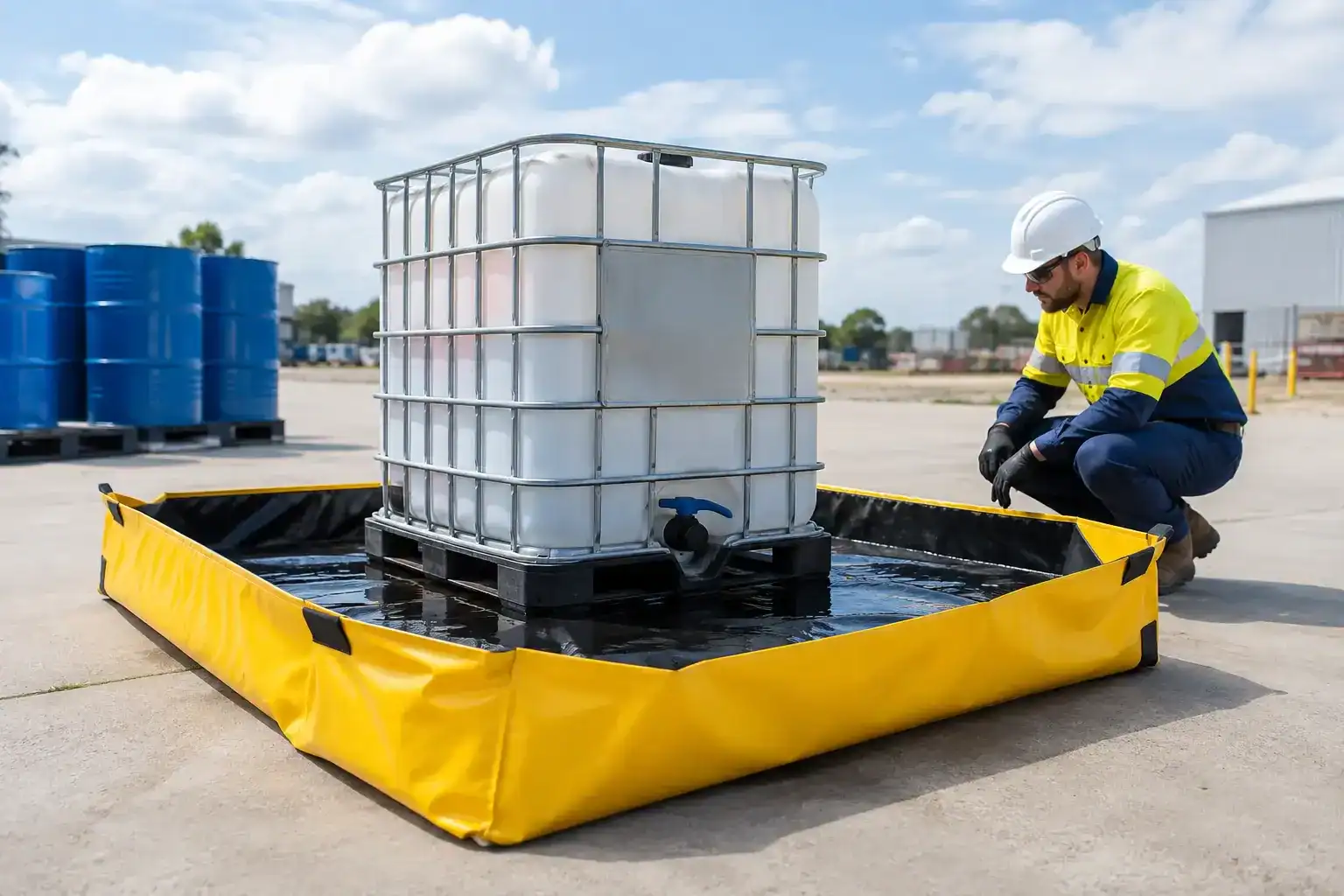
A spill berm review should start at the point of failure, not in a product catalogue. When a drum leaks, a hose fitting fails or a plant item is parked after a hydraulic fault, containment needs to work immediately. The right berm keeps the spill in a controlled area, protects drains and soil, and gives the crew time to recover liquid safely.
Portable spill berms are practical equipment for workshops, warehouses, transport depots, fuel-handling areas, construction sites and field maintenance operations. But capacities, wall designs and chemical compatibility vary considerably. A berm that is convenient to deploy may not be appropriate for a fully loaded IBC, while a heavy-duty drive-over model can be unnecessary for a small temporary drum-decanting task.
What a spill berm is designed to do
A spill berm is a portable containment enclosure with raised walls and a chemical-resistant base. It creates a temporary bunded area beneath equipment, containers or vehicles where leaks and spills could occur. Depending on the design, it may be used for drum storage, refuelling, wash-down work, plant maintenance, leaking packages or emergency containment.
Its role is containment, not clean-up. Once liquid is held within the berm, workers still need suitable absorbents, drain protection, personal protective equipment and a safe method for transferring recovered liquid into an approved waste container. Treating a berm as a complete spill response solution is a common purchasing mistake.
For Australian workplaces, the objective is straightforward: prevent hazardous liquids from reaching stormwater, unprotected ground, waterways or other areas where they create a safety and environmental risk. A well-selected berm also supports a cleaner response process, because it defines the affected area before the spill spreads under pallets, vehicles or machinery.
Spill berm review: assess the job before the product
The most useful way to compare spill berms is to define the credible spill scenario. This means considering the largest volume that could be released, the liquid involved, how the item will enter the berm and whether the containment is temporary or long-term.
A small folding berm may suit a maintenance contractor working beneath a ute or portable generator. It is quick to transport, can be deployed around equipment and is easy to store when not in use. Its limitation is capacity. If the work involves transferring fuel from a bulk container or storing multiple drums, a larger containment area with a higher wall is usually required.
For vehicle and plant maintenance, measure the equipment footprint with clearance for workers and spill-response access. The berm should not sit so tightly around tyres or tracks that a minor positioning error damages the wall. Include room for drip trays, absorbent pads and any containers used to collect recovered liquid.
Where drums, IBCs or plant will be moved into place, wall style matters as much as size. Foam walls allow vehicles to drive in and out without a ramp, then return to shape once the load has passed. They are useful for occasional access, although repeated traffic and sharp loads can shorten service life. Aluminium angle or bracket walls provide a more defined edge and can be suitable for static applications, but they usually require a ramp or careful loading arrangement. Collapsible wall designs offer another option where easy access is needed, provided the wall system is rated for the intended traffic and operating conditions.
Capacity is not a guess
Containment capacity should be based on the maximum reasonably foreseeable release, not the amount normally handled on a quiet day. If a 205-litre drum is being decanted, the berm needs enough usable capacity for a credible loss of product, plus a margin for rainfall or other liquids where it is used outdoors.
Do not rely on external dimensions alone. Berm capacity changes with wall height, internal footprint, wall construction and the space taken up by stored items. A berm occupied by drums or machinery has less free volume available than an empty berm of the same stated dimensions.
For larger storage applications, check your site requirements and the applicable Australian standards, environmental obligations and workplace procedures. Requirements may depend on the substance, storage volume, location and state or territory. A portable berm is often an operational control for temporary work, not a substitute for permanent bunding where permanent hazardous-liquid storage is required.
Rain is another practical consideration. An outdoor berm can collect water even when no spill has occurred. Water must not be discharged simply because it looks clean. Inspect it for signs of contamination and manage it under site procedures. If the area is exposed to regular weather, consider whether a covered storage location, spill pallet or fixed bund is a more suitable control.
Match the berm material to the liquid
Most quality spill berms use heavy-duty, flexible coated fabric designed to resist industrial liquids. That does not mean every model is suitable for every chemical. Oils, diesel, petrol, hydraulic fluid and coolant are common applications, but aggressive chemicals, solvents and oxidisers may need a specific material assessment.
Before purchase, identify the liquid by its safety data sheet and verify compatibility with the berm manufacturer’s information. Pay attention to concentration, temperature and contact duration. A berm may tolerate incidental contact during an emergency response but not be suitable for ongoing storage or lengthy exposure.
This check becomes especially important for mixed waste streams. A workshop may deal mainly with oil, yet a spill can include degreaser, coolant, battery electrolyte or solvent-based cleaner. If the operation handles multiple hazardous substances, select containment for the highest-risk realistic exposure rather than the most common one.
The same principle applies to absorbents. General-purpose pads are useful for many workshop liquids, while oil-only absorbents repel water and are suited to hydrocarbon spills. Chemical absorbents and PPE are needed where the substance presents a corrosive or hazardous exposure risk. The berm contains the liquid; the rest of the response equipment must match the hazard.
Check deployment, access and site conditions
A berm only helps if workers can deploy it correctly under pressure. Folding models need a clear, reasonably level surface free of sharp debris. In field conditions, that may mean preparing the area first rather than placing fabric directly over rocks, scrap metal or protruding bolts.
Look closely at the base fabric, seams, corners and wall supports. These are high-stress areas, particularly where heavy equipment is positioned or where vehicles cross into the containment area. Reinforced construction is valuable, but it does not remove the need to inspect the berm before each use.
For drive-in applications, confirm the traffic rating and follow the recommended entry method. A foam-wall berm is not an invitation to turn sharply on the wall, spin tyres or drag tracked equipment across the fabric. If equipment has sharp edges, metal tracks or a high point load, use a model specifically intended for that duty or use another containment method.
Temperature also affects handling. Flexible fabrics can become stiffer in cold conditions, while high heat, direct sun and chemical exposure can affect service life over time. Store the berm clean, dry and protected from unnecessary UV exposure. Folding it while contaminated can spread residue and make the next deployment less safe.
Common buying errors that create problems later
The lowest-cost berm is not always the lowest-cost containment option. Replacing a damaged unit, managing a spill that escaped the containment area or stopping work because access was poorly planned can cost far more than selecting the right configuration at the outset.
Four errors are particularly common:
- Buying to the smallest expected spill rather than the largest credible release.
- Choosing wall height without considering how vehicles, pallets or equipment will enter.
- Assuming material compatibility without checking the actual chemical and concentration.
- Using portable containment as permanent storage bunding without assessing site requirements.
Another issue is treating the berm as equipment that can be packed away immediately after a spill. Contaminated surfaces should be cleaned using a safe method appropriate to the substance, and damaged materials must be assessed before the berm is returned to service. Record significant spills, replenished absorbents and any equipment replacement under your site’s spill-response process.
A practical selection approach
Start with the liquid, then establish the largest likely release and the operating footprint. From there, choose a berm with suitable free capacity, compatible fabric and a wall design that matches access needs. Finally, confirm how it will be deployed, cleaned, stored and supported by absorbents, waste containers and PPE.
For a workshop with occasional oil leaks, a compact foldable berm and a correctly stocked spill kit may be the sensible combination. For fuel transfer, mobile plant servicing or drum handling, a larger drive-over or framed design may provide better control. For permanent storage of hazardous liquids, investigate fixed bunding or compliant spill pallets rather than relying on a temporary barrier.
Spillmaster supplies practical spill containment equipment for workplaces that need clear product selection and dependable operational safety. The right berm should make the safe action the easy action: contain the liquid at the source, keep it away from drains, and give your team the space to respond properly.