Spill Pallet vs Drip Tray for Safer Storage

A spill pallet vs drip tray decision usually comes down to one operational question: are you storing hazardous liquids, or simply managing the small leaks that occur while they are being used? Choosing the smaller, cheaper option for drum storage can leave a site exposed. Choosing a large pallet for a minor dispensing point can waste space and budget.
Both products provide secondary containment, but they are built for different volumes, traffic conditions and work practices. The right choice protects drains, keeps walkways clear and gives supervisors confidence that routine handling is not creating an avoidable environmental or compliance issue.
Spill pallet vs drip tray: the practical difference
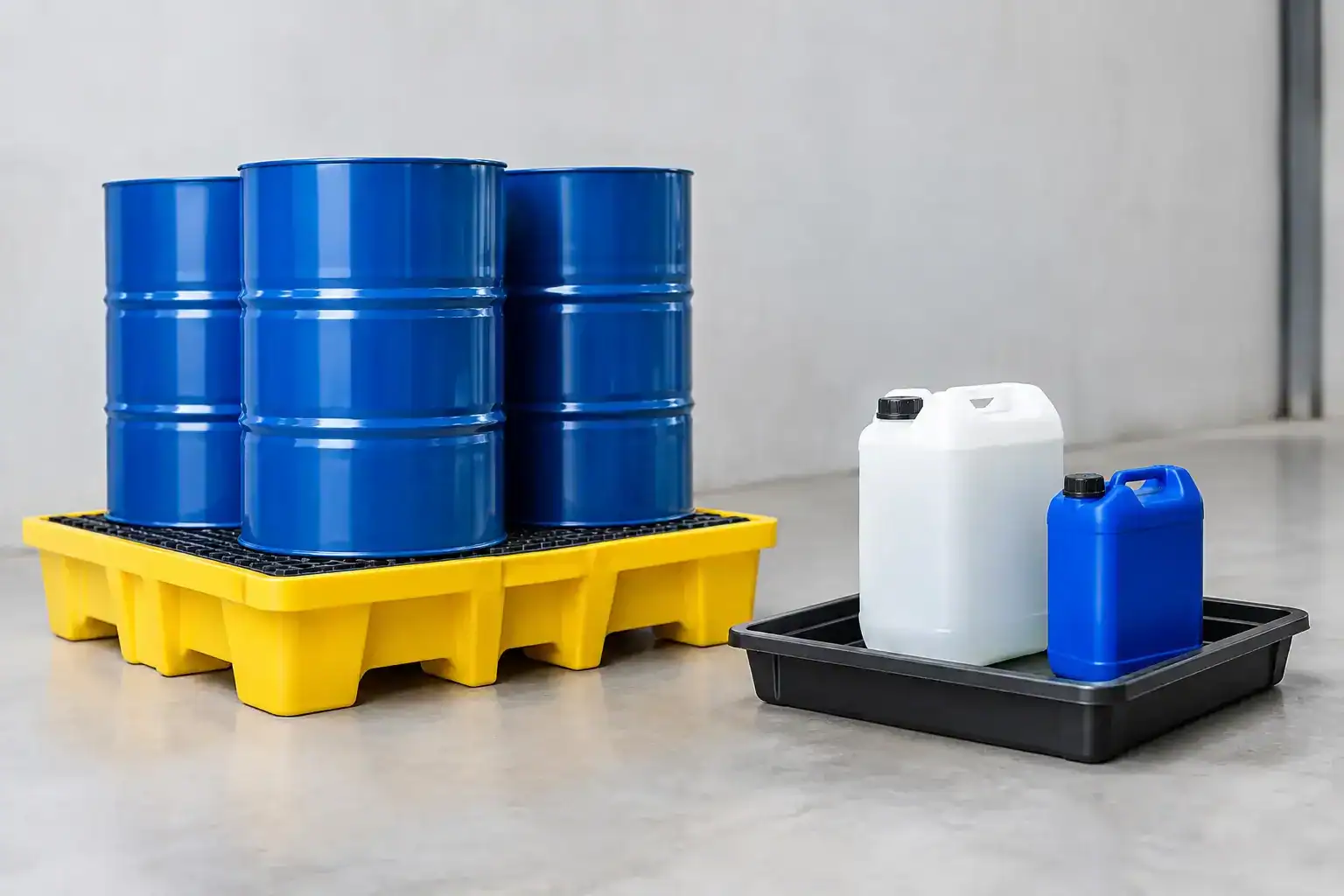
A spill pallet is a purpose-built bunded platform designed to hold drums, IBCs or other bulk liquid containers. It keeps the primary container raised above a contained sump, so a leak from a drum, bung or tap is captured before it reaches the floor. Spill pallets are commonly used in chemical stores, warehouses, workshops, fuel handling areas and maintenance compounds.
A drip tray is a low-profile tray intended to catch drips, minor leaks and residue beneath smaller containers, machinery or transfer points. It is generally lighter, more portable and easier to position under a workbench, pump, vehicle component or dispensing area. Its containment capacity is far lower than that of a spill pallet.
The distinction matters because secondary containment must match the credible spill volume, not just the amount of liquid likely to drip on an average day. A tray that manages a few millilitres from a valve may be completely unsuitable if a 205-litre drum fails.
When a spill pallet is the right choice
Use a spill pallet where drums or larger containers are stored for any meaningful period, particularly where they contain oils, fuels, solvents, corrosives or other hazardous substances. The pallet is the containment control for the stored inventory, rather than a clean-up accessory.
A two-drum or four-drum spill pallet suits a site that receives and stores standard drums before use. IBC spill pallets provide a larger bunded area for intermediate bulk containers, while drum work floors and modular bunding may be more appropriate where numerous containers are handled across a larger footprint.
Capacity is the first consideration. Many workplaces apply a rule that secondary containment should hold at least 110 per cent of the largest container, or 25 per cent of the total stored volume, depending on the storage arrangement and applicable requirements. The exact obligation can vary with the chemical, quantity, site location and relevant Australian standard, environmental authority or workplace requirement. Check the safety data sheet, site procedures and the rules that apply to your operation rather than relying on one general formula.
A spill pallet also needs to withstand the load placed on it. Add the weight of filled drums, pallets and any handling equipment used nearby. If drums are loaded by forklift, consider pallet design, access, ground conditions and whether a ramp is required for safe drum movement. A pallet that has adequate sump capacity but cannot be safely loaded or accessed is not fit for the task.
Material compatibility is equally important. Polyethylene pallets are widely used because they resist many oils, fuels and chemicals and will not corrode. However, compatibility is not universal. Strong oxidisers, certain solvents and site-specific process chemicals should always be checked against the product material and chemical information before purchase.
When a drip tray is the better fit
Drip trays work best at the point of use. Place one under a small container during decanting, beneath a hose connection, below a pump, or under equipment prone to minor oil seepage. They are also practical in service vehicles, on workbenches and under waste-oil collection points where a compact, moveable barrier is needed.
For example, a maintenance team may store new oil drums on a spill pallet in the chemical store, then use a drip tray under a portable oil dispenser while servicing plant. The pallet controls the risk of drum failure during storage. The tray captures the residual drips created by everyday work.
Drip trays are not a substitute for compliant drum bunding. Their shallow profile can make them useful in tight locations, but that same design limits their spill capacity. They can also overflow quickly if a container tips, a tap is left open or a line disconnects. If that failure is reasonably foreseeable, select a larger bunded unit or improve the dispensing setup.
Assess the liquid, container and task
The product decision should start with the substance being managed. Hydrocarbons may call for a different response plan from acids, alkalis or unknown mixed waste. A tray or pallet is only one control. Labelling, segregation, safe handling procedures, absorbents and access to a suitable spill kit all remain necessary.
Then consider the container. A five-litre jerry can on a bench has a different failure consequence from an IBC with a bottom outlet. Look at where the container sits, how often it is moved, who accesses it and whether it is exposed to vehicle traffic, weather or uneven ground.
Finally, consider the task. Static storage requires reliable bund capacity. Decanting requires capture beneath the transfer point. Mobile maintenance may require light, portable equipment. Waste accumulation may require a tray that can be emptied safely without spreading contamination.
This assessment often identifies a need for both products, not one or the other. A well-managed site uses spill pallets in storage areas and drip trays at the points where routine drips are most likely to occur.
Common selection mistakes
The most frequent mistake is selecting on footprint alone. A tray may fit neatly under a drum, yet provide insufficient capacity for a full leak. Measure the space, but calculate the containment volume first.
Another mistake is overlooking how the equipment will be used. If staff need to remove drums regularly, account for drum handling equipment, ramps and clear access. If a tray will sit under machinery, make sure it will not create a trip hazard or interfere with maintenance access.
Sites also sometimes mix incompatible liquids within one containment area. If a leak allows substances to combine, the result may be more hazardous than either material alone. Segregate incompatible chemicals and provide clearly identified containment for each group where required.
Poor housekeeping creates further problems. Rainwater, rubbish and accumulated residue reduce available sump capacity. Inspect pallets and trays routinely, remove contaminated liquid using approved methods, and arrange disposal in line with the waste classification and site procedures. Never empty contaminated liquid to a stormwater drain.
Set up secondary containment properly
Position spill pallets and drip trays on stable, level ground away from drains where practical. Keep drain covers or drain protection nearby if a release could reach stormwater. Ensure drums are closed when not in use, taps are protected from impact, and containers are not stacked or stored beyond the equipment’s rated capacity.
For outdoor locations, weather protection may be necessary to prevent rainwater filling the bund. It also reduces degradation of labels and keeps stored materials in better condition. Where forklift movements occur, use physical separation or guards so containment equipment is not struck.
Inspection should be part of routine site checks. Look for cracks, distortion, UV damage, chemical attack and pooled liquid. A tray or pallet that has been damaged, overloaded or exposed to an incompatible chemical should be removed from service until it has been assessed.
Buying for compliance and day-to-day use
Before ordering, document the number and size of containers, the liquid type, total stored volume, required containment capacity, load rating and available floor area. This gives procurement and safety teams a clear basis for comparing products rather than choosing by price alone.
It is also worth considering what happens after a spill. Absorbent pads, socks and granules should be available nearby, with a spill kit selected for the substances on site. Secondary containment buys time and limits spread. It does not remove the need to respond, report and dispose of contaminated materials correctly.
Spillmaster supplies spill pallets, drip trays, absorbents and related containment equipment for workplaces that need a practical, fit-for-purpose setup. Start with the largest credible release, then select equipment that makes routine work safer rather than harder. The best containment solution is the one your team can use correctly every shift, while still holding the spill that matters most.